

Is the vegetarian entrée at your holiday gathering often viewed as something less than the main event? Too often, plant-based options are relegated to simple sides or small, uninspired dishes. This year, we encourage you to challenge that outdated approach.
The festive season deserves meals that are truly celebratory, rich in flavor, and stunning in presentation. A stunning vegetarian centerpiece can easily anchor your entire meal, satisfying everyone at the table with its visual appeal and hearty textures.
Forget the tired reputation of meatless meals. We have gathered forty incredible, diverse recipes—from elegant Wellingtons to vibrant stuffed squashes and rich baked tarts. These dishes prove vegetarian food is not an afterthought; it is an opportunity for culinary brilliance. Prepare to transform your holiday table into a feast everyone will remember.
1. Festive Cranberry and Nut Wellington
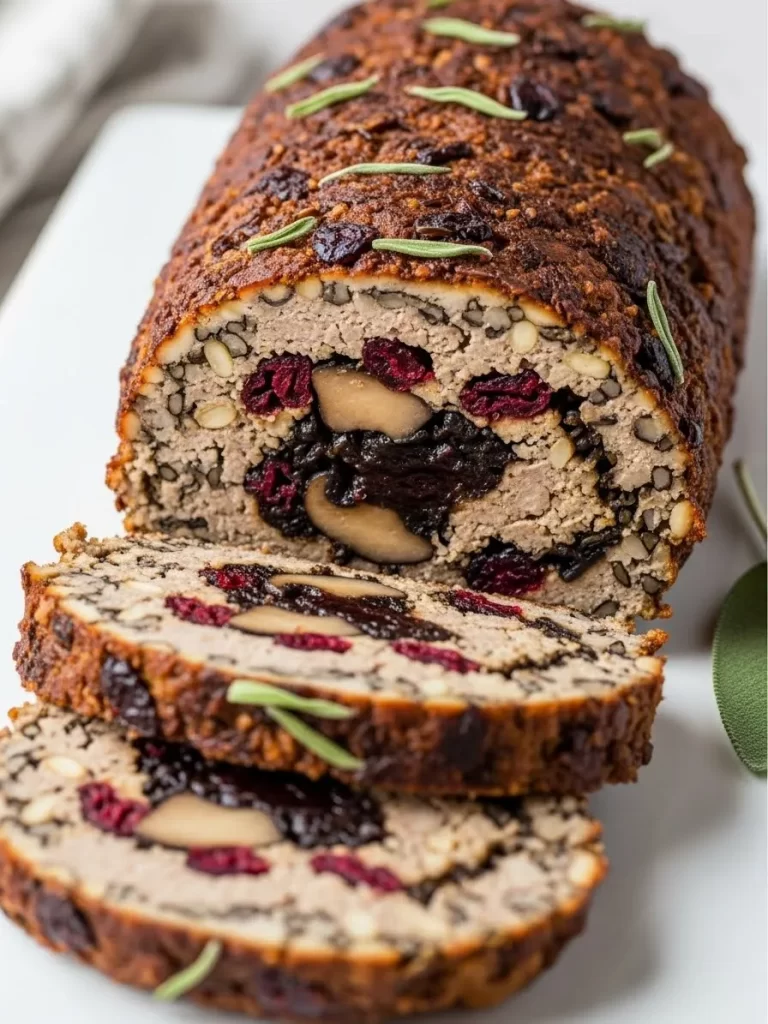
This stunning centerpiece proves vegetarian main dishes deserve the spotlight at any holiday table. A beautifully baked loaf sits sliced on a white platter, revealing a moist, savory interior brimming with seasonal flavors. The crust boasts a deep golden brown color, hinting at a satisfying crunch and aromatic herbs.
Inside, the loaf contains a rich filling packed with nuts and grains, creating a truly hearty texture. Visible throughout the cross-section are vibrant crimson cranberries and dark, earthy mushroom caps, adding a welcome burst of color and sweetness. This is a showstopper that will satisfy even the most committed meat-eaters during the festive season.
A sprinkle of fresh rosemary garnish across the top elevates its presentation to an art form. Imagine the wonderful aroma filling your kitchen as this bakes! This recipe transforms basic ingredients into an elegant, comforting holiday feast.
Required Ingredients
For the Loaf:
- 1 tablespoon olive oil
- 1 medium onion, finely chopped
- 2 cloves garlic, minced
- 8 ounces cremini or button mushrooms, finely chopped
- 1 cup mixed nuts (pecans, walnuts, and pine nuts work well), lightly toasted and roughly chopped
- 1 cup cooked brown rice or quinoa
- 1 cup dried cranberries
- 1/2 cup vegetable broth
- 1 tablespoon fresh sage, chopped
- 1 teaspoon fresh thyme leaves
- 1/4 cup nutritional yeast (optional, for cheesy flavor)
- 1/2 teaspoon salt
- 1/4 teaspoon black pepper
For the Center Filling (Optional Variation):
- 4 large portobello mushroom caps, stems removed
For Glazing:
- 1 tablespoon maple syrup
- 1 tablespoon vegetable broth
Equipment List
- Large skillet or frying pan
- Mixing bowl
- 9 x 5 inch loaf pan
- Parchment paper
- Measuring cups and spoons
- Sharp knife
- Cutting board
- Small bowl for glaze
DIY Instruction
Step 1: Sauté the Aromatics and Mushrooms
- Place your large skillet over medium heat and add the olive oil. Allow the oil to warm for about one minute.
- Add the finely chopped onion to the skillet. Cook, stirring occasionally, until the onion becomes translucent and soft, which usually takes about 5 to 7 minutes.
- Toss in the minced garlic and chopped mushrooms. Continue to cook, stirring frequently, until the mushrooms have released their moisture and begun to brown slightly. This process concentrates their flavor and takes approximately 8 to 10 minutes.
- Remove the skillet from the heat and allow the mixture to cool slightly.
Step 2: Prepare the Loaf Mixture
- In a spacious mixing bowl, combine the cooled mushroom and onion mixture with the chopped nuts, cooked brown rice or quinoa, and dried cranberries.
- Add the vegetable broth, chopped fresh sage, fresh thyme leaves, and nutritional yeast (if using) to the bowl.
- Season the entire mixture with the salt and black pepper.
- Use a sturdy spoon or your hands to thoroughly mix all the ingredients together until they are well combined and the mixture holds its shape when gently pressed. If the mixture seems too dry, add a small splash more vegetable broth.
Step 3: Assemble and Shape the Loaf
- Preheat your oven to 375°F (190°C).
- Line your 9 x 5 inch loaf pan with parchment paper, leaving an overhang on the longer sides. This overhang will act as a sling to help you easily lift the baked loaf out of the pan.
- Place about two-thirds of the loaf mixture into the prepared pan. Press it down firmly and evenly to form the bottom layer.
- If you are using the optional center filling, place the four portobello mushroom caps stem-side down, arranging them snugly in a line down the center of the loaf mixture.
- Carefully place the remaining one-third of the loaf mixture on top of the mushrooms. Press the mixture down again, sealing the sides and ensuring the loaf is neatly formed.
Step 4: Bake the Loaf
- Combine the maple syrup and the tablespoon of vegetable broth in a small bowl; this is your glaze.
- Brush the top of the formed loaf generously with this glaze mixture.
- Bake the loaf in the preheated oven for approximately 45 to 55 minutes. The crust should look deep golden brown and feel firm to the touch when ready.
- Once baked, carefully lift the loaf out of the pan using the parchment paper sling. Place it onto a wire rack to cool for at least 10 to 15 minutes before slicing. Cooling helps it set and prevents crumbling when sliced.
2. Caramelized Onion and Tofu Wellington
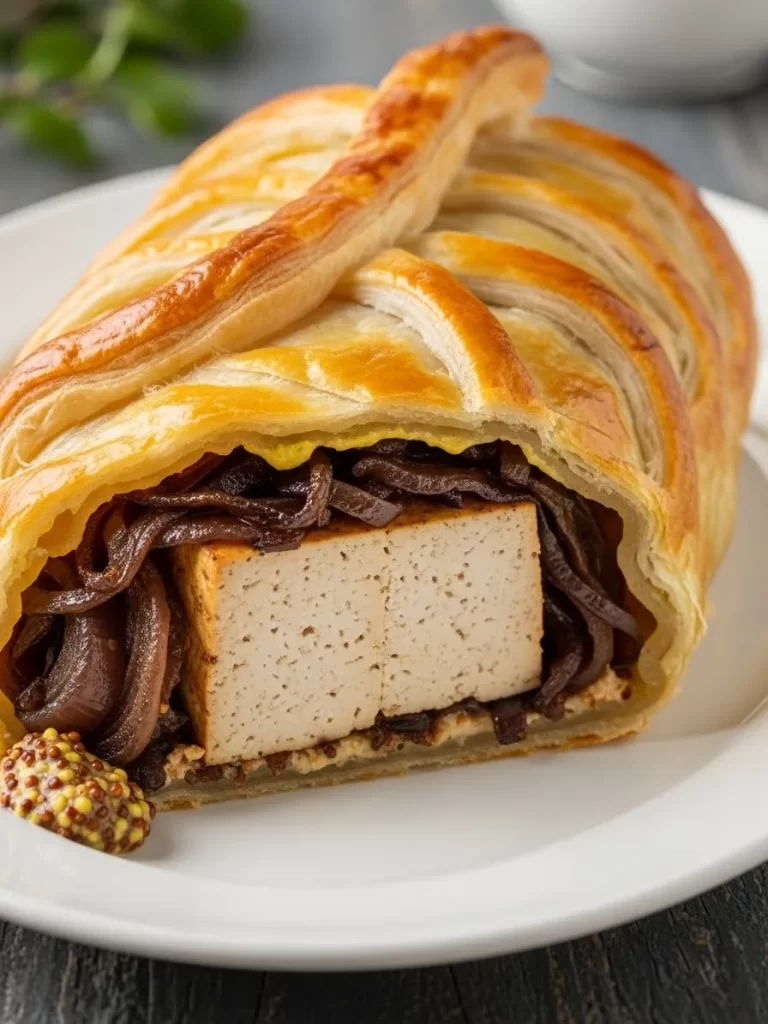
This savory Wellington offers a hearty and deeply satisfying main course, showcasing an impressive filling wrapped in a flaky golden crust. The pastry is beautifully braided across the top, lending an air of sophisticated elegance to the presentation. You can clearly see the rich, golden-brown glaze achieved by baking.
The interior holds a substantial block of firm tofu, seasoned expertly to stand as the meal’s anchor. Surrounding the tofu is a generous layer of richly caramelized red onions, cooked down slowly until wonderfully sweet and tender. This creates a powerful savory contrast to the milder protein core.
A small dollop of whole grain mustard accompanies the sliced end of the dish, hinting at the complementary flavors served alongside it. This is a wonderfully rustic and comforting dish, truly worthy of a special occasion centerpiece that elevates simple ingredients to holiday-worthy status.
Required Ingredients
For the Tofu and Filling:
- 1 block (14-16 oz) extra-firm tofu, pressed and cut into a neat block (roughly 4x2x2 inches)
- 2 tablespoons soy sauce or tamari
- 1 tablespoon olive oil
- 3 large red onions, thinly sliced
- 1 tablespoon balsamic vinegar
- 1 tablespoon fresh thyme leaves
- 1/2 teaspoon smoked paprika
- Salt and freshly ground black pepper to taste
- 1 sheet ready-rolled puff pastry (thawed)
For the Pastry Glaze:
- 1 tablespoon non-dairy milk (like almond or soy)
- 1/2 teaspoon maple syrup
Equipment List
- Tofu press or heavy objects for pressing
- Sharp knife and cutting board
- Large skillet or frying pan
- Small bowl
- Baking sheet
- Parchment paper
- Pastry brush
DIY Instruction
Step 1: Press and Marinate the Tofu
- If you haven’t already, press the block of extra-firm tofu for at least 30 minutes to remove excess moisture. Pressing is essential for texture.
- Once pressed, brush or rub the tofu block with the 2 tablespoons of soy sauce or tamari, coating all sides evenly. Set it aside to absorb the flavor while you prepare the onions.
Step 2: Caramelize the Red Onions
- Heat the tablespoon of olive oil in your large skillet over medium-low heat. Add the thinly sliced red onions.
- Cook the onions slowly for 25 to 35 minutes, stirring occasionally. The key here is patience; you want them to soften completely and turn a deep, rich brown color, which maximizes their natural sweetness.
- When the onions are caramelized, stir in the balsamic vinegar, fresh thyme, and smoked paprika. Cook for another 2 minutes until the liquid reduces.
- Season the caramelized onions with salt and pepper. Remove them from the heat and let them cool slightly.
Step 3: Assemble the Wellington
- Preheat your oven to 400°F (200°C). Line a baking sheet with parchment paper.
- Carefully unroll the thawed puff pastry sheet onto the prepared baking sheet.
- Spread about two-thirds of the caramelized onion mixture evenly down the center of the pastry sheet, forming a bed for the tofu that is roughly the same size as the tofu block.
- Place the marinated tofu block directly on top of the onions. Spread the remaining caramelized onions around the sides of the tofu block.
- Cut diagonal strips into the puff pastry on both sides of the filling. The strips should be about 1 inch wide and angled toward the tofu.
Step 4: Fold and Bake
- Gently fold the top and bottom edges of the pastry over the ends of the tofu block to seal them completely.
- Starting at one end, lift the pastry strips from opposite sides and cross them over the filling, creating a braided or criss-cross pattern. Press the edges together firmly to seal the Wellington entirely.
- In a small bowl, whisk together the non-dairy milk and maple syrup for the glaze. Brush this mixture liberally over the entire surface of the pastry.
- Bake for 25 to 30 minutes, or until the puff pastry is puffed up, deep golden brown, and cooked through.
- Allow the Wellington to rest for 5 to 10 minutes before slicing and serving.
3. Layered Chestnut and Apple Terrine with Balsamic Glaze
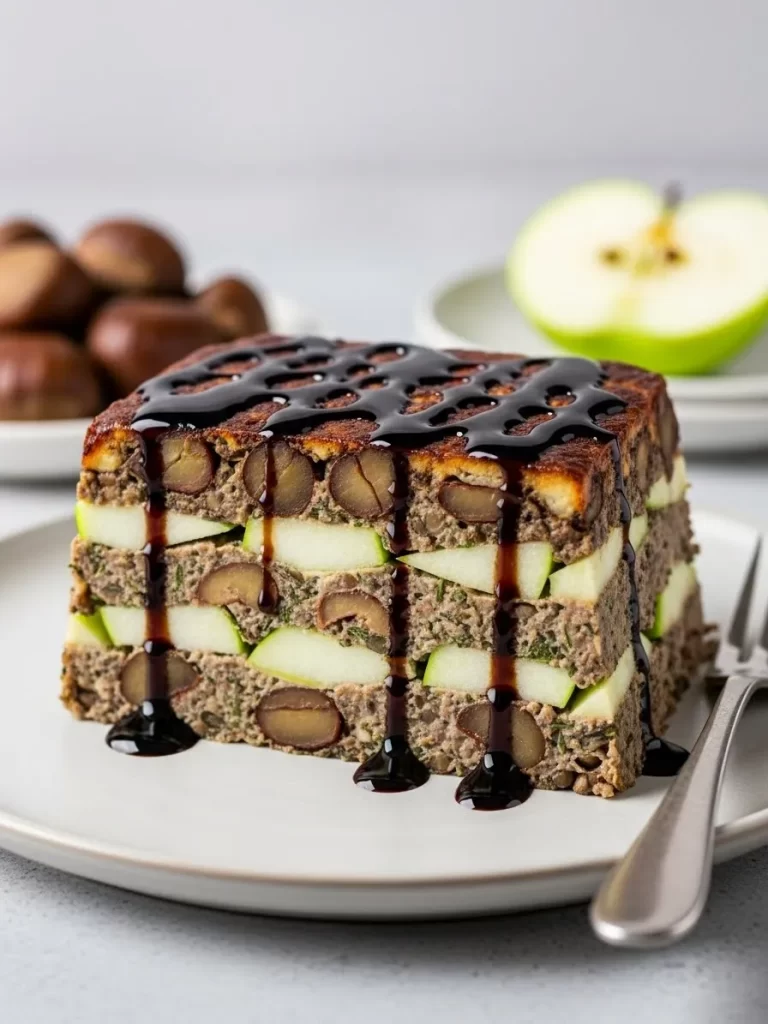
This striking terrine presents a beautiful architectural display, featuring alternating layers of savory stuffing and fresh autumnal fruit. Sliced into a neat, thick square, the dish reveals its intriguing contents, making it a wonderful visual focal point for the table.
Layers of a rich, herb-flecked mushroom or lentil loaf mixture alternate gracefully with crisp, thinly sliced green apples. Whole, roasted chestnuts are arranged between the layers, adding a meaty texture and earthy sweetness that complements the other ingredients wonderfully.
Finally, a thick, glossy balsamic glaze is drizzled artfully over the top, creating elegant dark streaks down the sides of the layered structure. This provides a tangy, sweet-and-sour counterpoint to the savory and nutty flavors within. It’s a sophisticated and truly memorable holiday offering.
Required Ingredients
For the Terrine Base:
- 1 tablespoon olive oil
- 1 medium onion, finely chopped
- 8 oz cremini mushrooms, finely chopped
- 1 cup cooked lentils or walnuts (or a mix)
- 1/2 cup breadcrumbs
- 1/4 cup vegetable broth
- 1 tablespoon fresh sage, chopped
- 1 teaspoon fresh thyme leaves
- Salt and black pepper to taste
For the Layers:
- 1 cup whole roasted and peeled chestnuts (canned or vacuum-packed work well)
- 2 small Granny Smith or other tart green apples, thinly sliced
For the Balsamic Glaze:
- 1/2 cup balsamic vinegar
Equipment List
- 8 x 4 inch loaf pan or terrine mold
- Parchment paper
- Large skillet
- Food processor (optional, for the base mixture)
- Small saucepan
- Cutting board and sharp knife
DIY Instruction
Step 1: Prepare the Terrine Base
- Preheat your oven to 375°F (190°C). Line the loaf pan or terrine mold with parchment paper, leaving an overhang on the sides.
- Heat the olive oil in the large skillet over medium heat. Add the chopped onion and cook until softened, about 5 minutes.
- Add the chopped mushrooms and cook until their moisture evaporates, approximately 8-10 minutes. Remove from heat.
- In a food processor, pulse the cooked lentils (or walnuts) until roughly chopped. Transfer this to a mixing bowl.
- Add the mushroom mixture, breadcrumbs, vegetable broth, chopped sage, thyme, salt, and pepper to the bowl. Mix everything thoroughly until well combined and the mixture is firm enough to shape.
Step 2: Assemble the Terrine Layers
- Place about one-third of the terrine base mixture into the prepared pan. Press it down very firmly to create an even bottom layer.
- Arrange half of the thinly sliced green apples over the base layer, overlapping them slightly.
- Scatter half of the whole chestnuts evenly over the apple layer.
- Carefully add the second third of the terrine base mixture on top of the chestnuts. Press this layer down gently but firmly.
- Repeat the apple and chestnut layering: arrange the remaining apple slices, followed by the remaining chestnuts.
- Finally, top with the last third of the terrine base mixture, pressing the top layer down to ensure a compact, even surface.
Step 3: Bake the Terrine
- Cover the loaf pan tightly with aluminum foil.
- Bake for 50 to 60 minutes. The terrine should feel firm to the touch when ready.
- Once baked, remove the foil and let the terrine cool completely in the pan for at least 1 hour, or chill it in the refrigerator for several hours. This is crucial for maintaining the layered structure when sliced.
Step 4: Make the Balsamic Glaze and Serve
- In a small saucepan, pour in the balsamic vinegar. Bring it to a simmer over medium heat.
- Reduce the heat to low and allow the vinegar to simmer gently for 10 to 15 minutes, or until it has thickened to a syrupy consistency. Watch carefully to prevent burning.
- Use the parchment paper overhang to lift the cooled terrine out of the pan. Slice it into thick squares or slices.
- Drizzle the warm balsamic glaze generously over each slice right before serving.
4. Jewel-Toned Stuffed Mini Pumpkins
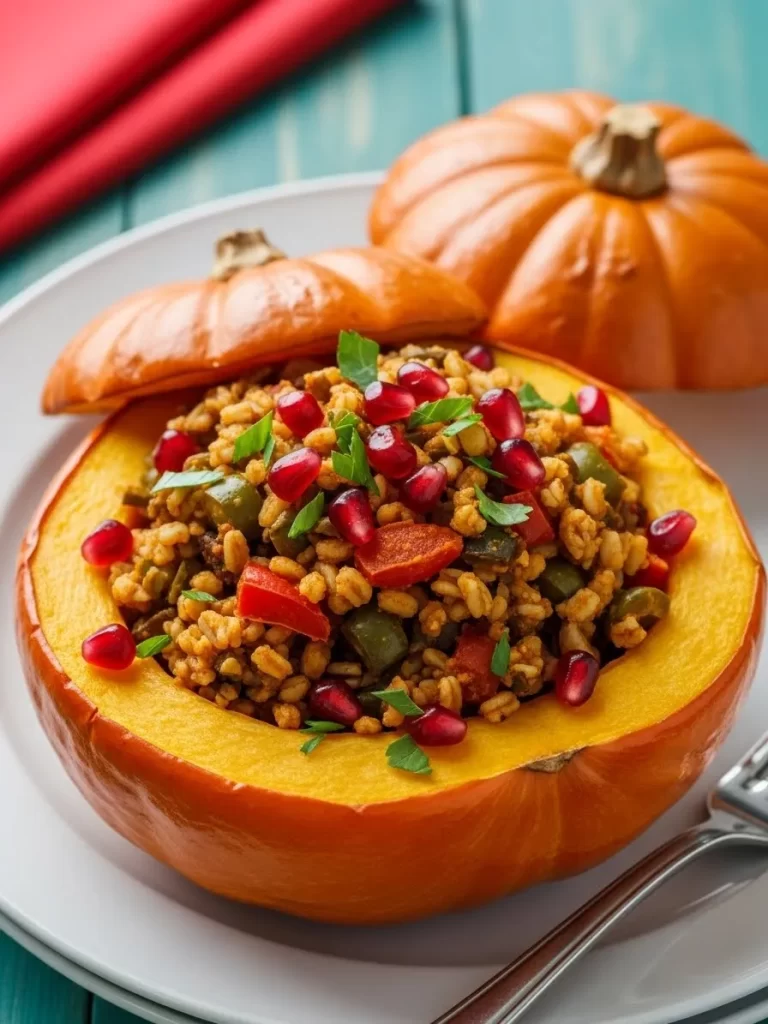
This festive dish truly captures the bounty of the harvest, presenting a vibrant, flavorful grain mixture served directly inside a roasted mini pumpkin. The presentation is visually stunning and requires minimal serving effort, making it a great holiday option.
The roasted pumpkin shell displays a rich orange hue and slightly crusted edges, indicating its sweet, earthy flavor. The lid, placed slightly ajar next to the main bowl, adds a whimsical touch.
Inside, the filling is a beautiful blend of hearty grains, likely farro or barley, mixed with colorful seasonal vegetables like red peppers and green beans. Bright, ruby-red pomegranate seeds are sprinkled generously over the top, along with fresh parsley, adding a wonderful textural pop and fruity zing. This is a complete, satisfying meal celebrating autumn flavors.
Required Ingredients
For the Stuffed Pumpkins:
- 4 small edible pumpkins or squash (such as acorn or sugar pumpkin), about 1 pound each
- 1 tablespoon olive oil, plus more for rubbing
- 1 medium onion, diced
- 1 red bell pepper, diced
- 1/2 cup green beans, chopped
- 1 clove garlic, minced
- 1 cup cooked farro or barley
- 1/2 cup vegetable broth
- 1 teaspoon smoked paprika
- 1/2 teaspoon cumin
- Salt and black pepper to taste
- 1/4 cup fresh parsley, chopped
- 1/4 cup pomegranate seeds, for garnish
Equipment List
- Baking sheet
- Sharp knife
- Spoon or melon baller
- Large skillet
- Measuring cups and spoons
DIY Instruction
Step 1: Prepare and Roast the Pumpkins
- Preheat your oven to 375°F (190°C).
- Carefully slice off the top of each mini pumpkin to create a lid. Use a sturdy spoon or melon baller to scoop out all the seeds and stringy membranes from inside the pumpkins.
- Brush the cut edges and insides of the pumpkins and their lids lightly with olive oil. Season the insides with a pinch of salt and pepper.
- Place the pumpkins and their lids (cut side up) on a baking sheet.
- Roast for 30 to 40 minutes, or until the flesh is tender when pierced with a fork. Remove them from the oven and let them cool slightly while you prepare the filling.
Step 2: Prepare the Savory Grain Filling
- While the pumpkins are roasting, heat the tablespoon of olive oil in a large skillet over medium heat.
- Add the diced onion and cook until it softens, about 5 to 7 minutes.
- Stir in the diced red bell pepper and chopped green beans. Continue cooking for another 5 minutes until the vegetables start to become tender-crisp.
- Toss in the minced garlic, smoked paprika, and cumin to the skillet. Cook for just 1 minute until fragrant.
- Stir in the cooked farro or barley and the vegetable broth. Bring the mixture to a simmer, then cook until most of the broth is absorbed and the grain mixture is moist, about 3 to 5 minutes.
- Taste the filling and adjust the seasoning with salt and pepper as needed. Remove from the heat and stir in the chopped fresh parsley.
Step 3: Assemble and Serve
- Spoon the savory grain filling generously into the cavity of each roasted pumpkin.
- Garnish the top of the filling in each pumpkin with a scattering of bright pomegranate seeds.
- Place the pumpkin lid slightly to the side or on top of the filling.
- Serve the stuffed pumpkins warm on individual plates as an impressive main dish.
5. Rich Beetroot, Feta, and Thyme Puff Pastry Tart
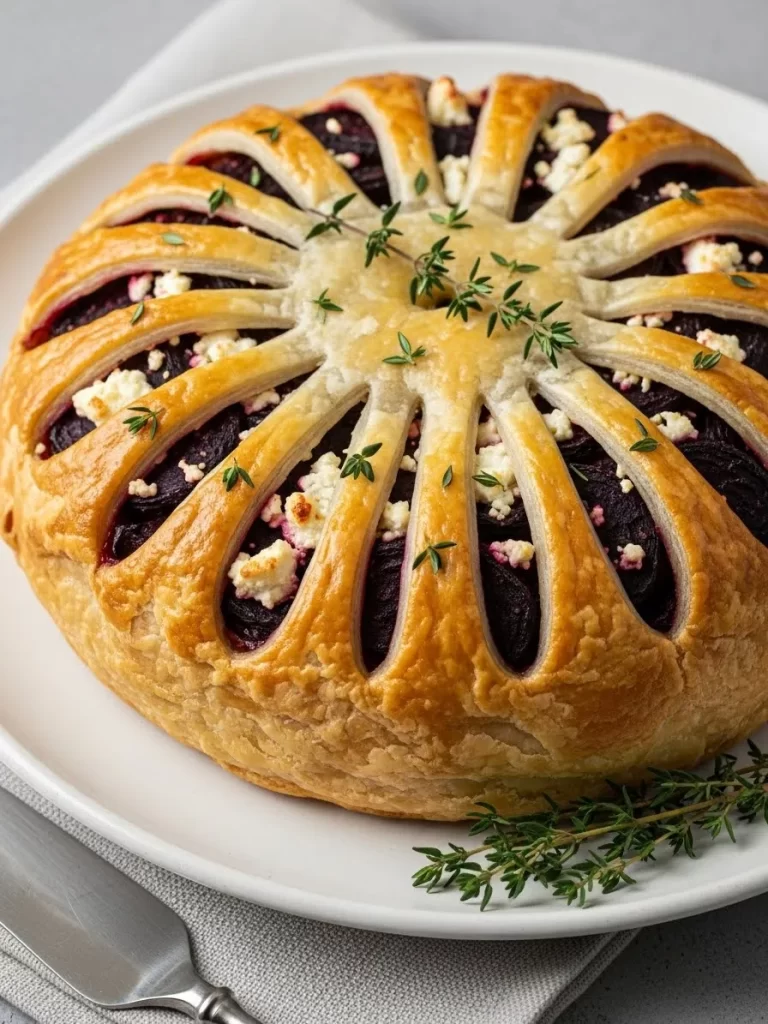
This visually striking tart serves as a magnificent centerpiece, boasting a sunburst pattern that showcases its vibrant, sweet, and savory components. The golden puff pastry is baked to a deep, flaky crispness, radiating outward from the center.
The tart’s filling is a stunning shade of deep magenta, created by thinly sliced roasted or steamed beetroot arranged in an elegant, overlapping circle. The dark color contrasts beautifully with the flaky pastry crust.
Scattered across the beetroot are creamy white crumbles of feta cheese, lending a salty, tangy counterpoint to the sweetness of the root vegetable. Tiny sprigs of fresh thyme are tucked into the cutouts, adding a beautiful herbal aroma and finish. This dish is truly a simple, yet elegant, holiday main course.
Required Ingredients
- 1 sheet ready-rolled puff pastry (thawed)
- 4 medium beetroots (cooked, peeled, and thinly sliced)
- 1 tablespoon olive oil
- 1/2 teaspoon salt
- 1/4 teaspoon black pepper
- 4 oz feta cheese, crumbled
- 1 egg (beaten, for egg wash) or non-dairy milk (for vegan wash)
- 1 tablespoon fresh thyme leaves (or small sprigs for garnish)
- 1 tablespoon honey or maple syrup (optional, for extra glaze)
Equipment List
- Baking sheet
- Parchment paper
- Small bowl
- Sharp knife
- Pastry brush
- 8 or 9 inch round plate or bowl for tracing
DIY Instruction
Step 1: Prepare the Pastry and Beets
- Preheat your oven to 400°F (200°C). Line a baking sheet with parchment paper.
- Unroll the puff pastry sheet onto the parchment paper. Place an 8- or 9-inch round plate in the center of the pastry and lightly cut a circle. Do not remove the excess pastry yet.
- Use a smaller bowl or ring to mark an inner circle in the center of the larger one (about 2 inches in diameter).
- Using a sharp knife, make radial cuts from the inner circle out to the edge of the large circle. You should aim for about 16 to 20 spokes, leaving the central 2-inch circle uncut.
- In a small bowl, toss the sliced beetroot with the olive oil, salt, and pepper.
Step 2: Assemble the Tart
- Starting from the outside of the central uncut circle, layer the sliced beetroot in a concentric pattern on the pastry. Overlap the slices slightly as you work your way outward toward the edges of the pastry.
- Sprinkle the crumbled feta cheese evenly over the beetroot layer.
- If using, lightly brush the outer pastry edges (the “spokes”) with the beaten egg or non-dairy wash.
- Carefully lift and gently twist each pastry spoke (the part you cut radially) 90 degrees so that the cut side faces upward, exposing the beetroot underneath. This creates the sunburst effect.
Step 3: Bake and Glaze
- Bake for 20 to 25 minutes, or until the pastry is puffed and deep golden brown.
- Remove the tart from the oven. If using, mix the honey or maple syrup with a teaspoon of water and brush this light glaze over the exposed beetroot (avoiding the pastry).
- Garnish the center of the tart and the gaps between the spokes with fresh thyme sprigs or leaves.
- Let the tart cool for a few minutes before transferring it to a serving plate and slicing.
6. Hazelnut-Crusted Celebration Loaf with Cranberry Glaze
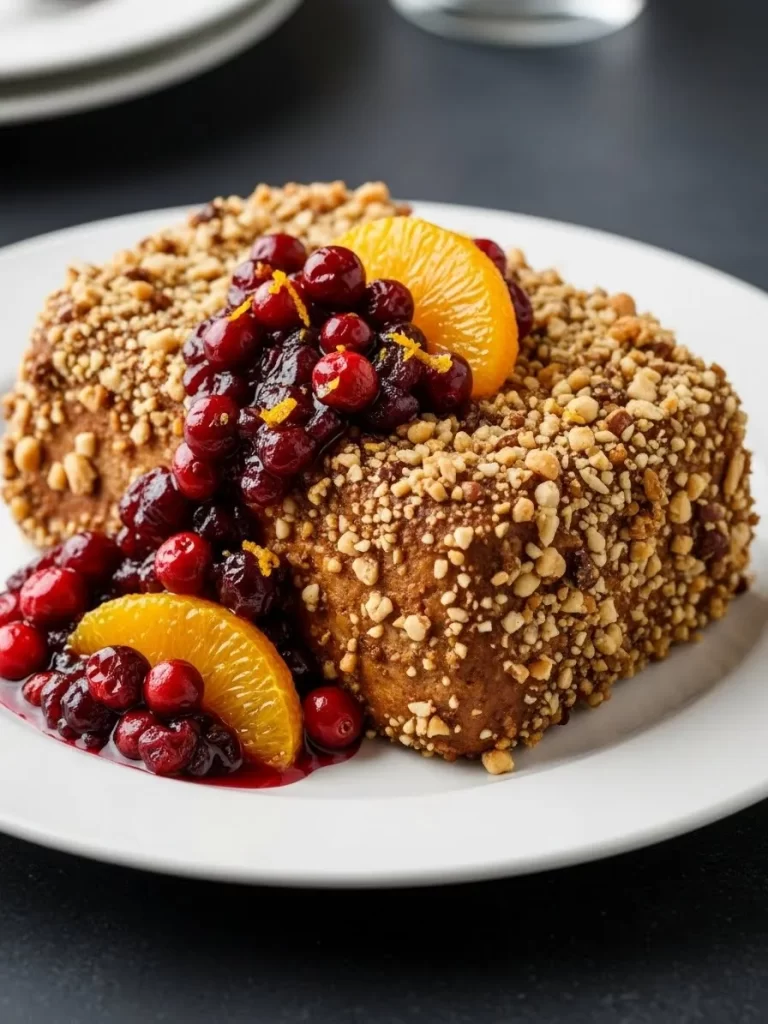
This holiday loaf is an opulent vegetarian presentation, featuring a rich, savory crust and a glossy fruit topping. The main dish is shaped into an appealing rectangular loaf and is heavily coated in finely chopped nuts, giving it a textural, rustic appearance.
The entire surface is covered in a crunchy hazelnut (or similar nut) crust that has toasted to a light brown color during baking. This coating ensures a satisfying crunch with every bite, contrasting beautifully with the loaf’s moist interior.
Cascading over the top is a vibrant, homemade cranberry sauce or relish, studded with whole berries and bright orange slices. The contrast between the deep red sauce and the nutty brown crust is visually stunning. This festive combination of flavors—nutty, savory, tart, and sweet—is absolutely essential for a holiday meal.
Required Ingredients
For the Loaf:
- 1 tablespoon olive oil
- 1 medium onion, finely chopped
- 2 cloves garlic, minced
- 1 cup finely chopped mushrooms (cremini or button)
- 1 cup vegetable broth
- 2 cups cooked lentils or kidney beans, mashed
- 1 cup breadcrumbs (or rolled oats)
- 1/2 cup fresh parsley, chopped
- 1 tablespoon soy sauce or tamari
- 1 teaspoon dried sage
- Salt and black pepper to taste
For the Crust and Topping:
- 1/2 cup finely chopped hazelnuts or walnuts
- 1 cup whole fresh or frozen cranberries
- 1/4 cup sugar or maple syrup
- Zest and juice of 1 small orange
- 2 thin orange slices, for garnish
Equipment List
- 9 x 5 inch loaf pan
- Parchment paper
- Large skillet
- Mixing bowl
- Small saucepan
- Cutting board and knife
DIY Instruction
Step 1: Prepare the Loaf Base
- Preheat your oven to 375°F (190°C). Line a 9 x 5 inch loaf pan with parchment paper, leaving an overhang.
- Heat the olive oil in the large skillet over medium heat. Sauté the chopped onion until soft, about 5 minutes.
- Add the minced garlic and chopped mushrooms; cook until the moisture evaporates, about 5-7 minutes.
- Transfer the vegetable mixture to a large mixing bowl. Add the mashed lentils or beans, breadcrumbs/oats, vegetable broth, parsley, soy sauce, sage, salt, and pepper.
- Mix thoroughly until the mixture is uniform and holds its shape well.
Step 2: Form the Loaf and Add the Crust
- Press half of the chopped hazelnuts/walnuts firmly into the bottom of the prepared loaf pan.
- Gently press the loaf mixture into the pan over the nuts, ensuring the top is smooth and even.
- Press the remaining chopped nuts firmly onto the top surface of the loaf mixture.
- Bake for 50 to 60 minutes, or until the loaf is firm to the touch and the nutty crust is golden brown.
Step 3: Prepare the Cranberry Glaze
- While the loaf bakes, combine the cranberries, sugar/maple syrup, orange zest, and orange juice in a small saucepan.
- Bring the mixture to a simmer over medium heat. Reduce the heat and cook gently for 10 to 15 minutes, stirring occasionally, until the cranberries burst and the sauce thickens slightly. Let it cool slightly.
Step 4: Finish and Serve
- Once baked, use the parchment paper overhang to carefully lift the loaf out of the pan. Let it cool for 10 to 15 minutes before serving.
- Transfer the loaf to a serving platter.
- Spoon the warm cranberry glaze generously over the top of the loaf.
- Garnish with the orange slices before presenting it to your guests.
7. Rustic Caramelized Onion and Swiss Cheese Tart
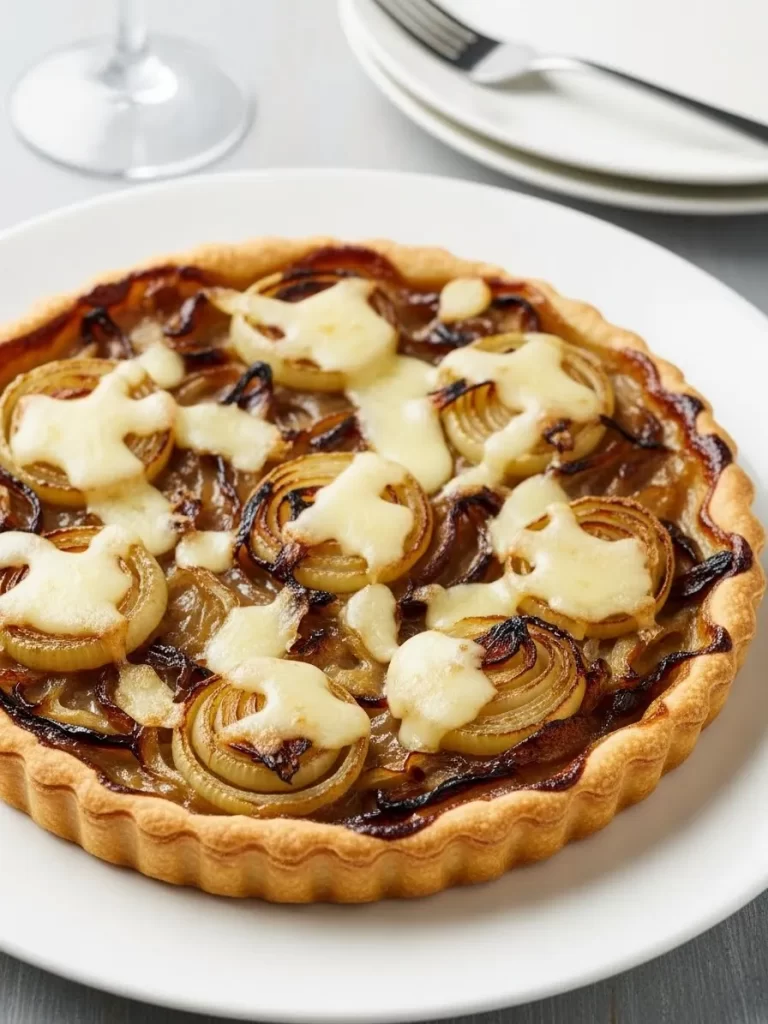
This savory tart makes an elegant and satisfying main dish, featuring a beautiful arrangement of sweet, dark onions set in a flaky pastry shell. The presentation is simple yet refined, making it a great option for a less formal gathering.
The crust boasts a scalloped, golden edge, suggesting a delightful crunch that holds a rich, sweet filling. The base is generously piled with deeply caramelized onions, cooked down until they are jammy and intensely flavored, creating a wonderful sweet and savory contrast.
A few rounds of melted cheese, likely a Gruyère or Swiss, dot the top of the onions, adding a creamy, savory bite and a lovely golden-brown char in spots. This tart delivers deep, comforting flavors that pair exceptionally well with a side salad and a glass of festive wine.
Required Ingredients
- 1 sheet ready-rolled savory shortcrust pastry (thawed) or pie dough
- 3 tablespoons butter or olive oil
- 4 large yellow onions, thinly sliced
- 1 tablespoon fresh thyme leaves
- 1 teaspoon salt
- 1/4 teaspoon black pepper
- 1 tablespoon balsamic vinegar (optional, for deeper flavor)
- 4 oz Swiss or Gruyère cheese, thinly sliced or roughly grated
- 1 egg (beaten, for brushing the crust)
Equipment List
- 9-inch tart pan with a removable bottom
- Large skillet
- Cutting board and sharp knife
- Pastry brush
DIY Instruction
Step 1: Prepare the Pastry Shell
- Preheat your oven to 375°F (190°C).
- Gently unroll the pastry sheet and carefully press it into the 9-inch tart pan. Trim the excess pastry around the rim and use the back of a knife or your fingers to press the dough neatly against the scalloped edges of the pan.
- Prick the bottom of the pastry shell all over with a fork. Bake the shell “blind” (unfilled) for 10 minutes. Remove it from the oven and reduce the oven temperature to 350°F (175°C).
Step 2: Caramelize the Onions
- Melt the butter or heat the olive oil in the large skillet over medium-low heat. Add the thinly sliced onions.
- Cook the onions slowly for 30 to 45 minutes, stirring every few minutes. The low heat is essential for drawing out their sweetness and achieving a deep, even caramelization without burning them.
- Once the onions are a rich, dark golden brown, stir in the fresh thyme, salt, and pepper. If using, add the balsamic vinegar and cook for 1 minute until absorbed. Remove from heat and allow the mixture to cool slightly.
Step 3: Assemble and Bake the Tart
- Spoon the cooled caramelized onion mixture evenly into the pre-baked pastry shell.
- Arrange the slices or clumps of Swiss or Gruyère cheese evenly over the top of the onions.
- Brush the outer edge of the pastry crust with the beaten egg for a deep golden finish.
- Bake for an additional 20 to 25 minutes, or until the cheese is melted and bubbly and the crust is fully golden brown.
- Let the tart cool for 5 to 10 minutes before carefully removing the outer rim of the tart pan. Serve warm or at room temperature.
8. Hearty Vegetable and Breadcrumb Stuffing Bake
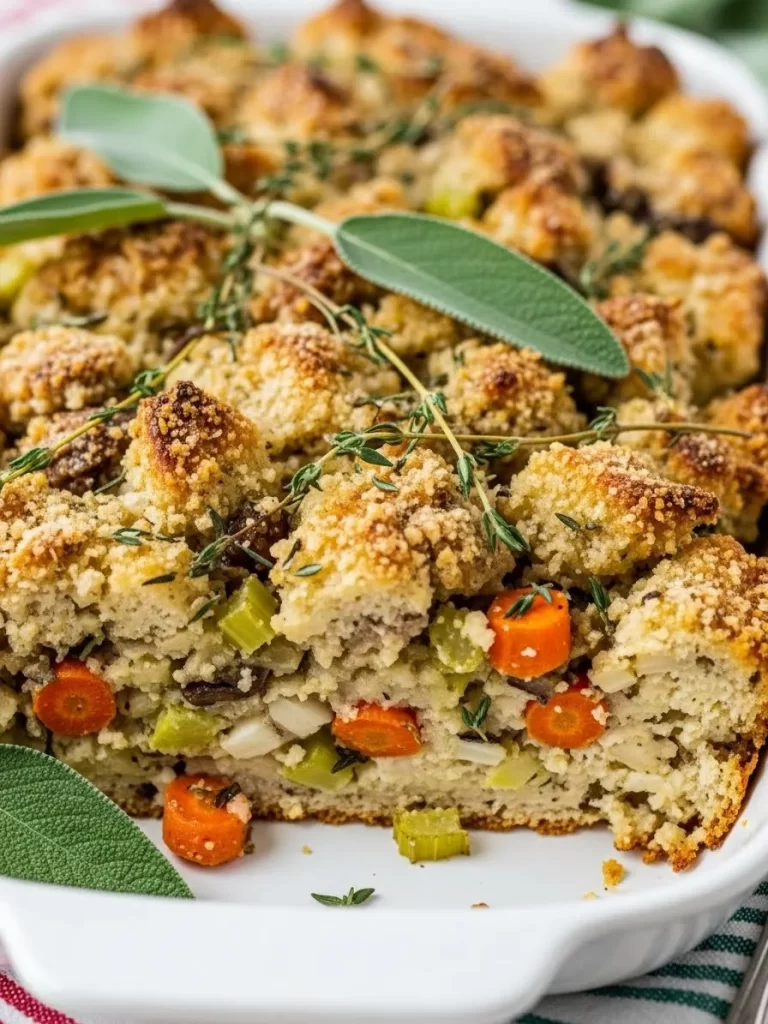
This comforting bake is an essential component of any holiday feast, elevated here to a main dish with its robust texture and savory flavors. The dish, presented in a classic white baking dish, has a wonderfully crusty top that looks incredibly inviting.
The stuffing features a golden, crispy breadcrumb topping that provides an appealing contrast to the softer, moist interior. Scattered across the surface are fresh sprigs of sage and thyme, adding a beautiful herbal finish and fragrance.
Looking at the cross-section, the interior is rich with seasonal vegetables: chunks of bright orange carrots, light green celery pieces, and bits of earthy mushroom are visible throughout the moist, flavorful bread mixture. This bake is a complete and satisfying meal, full of traditional holiday warmth and flavor.
Required Ingredients
- 2 tablespoons olive oil or butter
- 1 large onion, chopped
- 3 stalks celery, chopped
- 2 medium carrots, chopped
- 8 oz cremini or button mushrooms, sliced
- 1/2 cup vegetable broth, plus more if needed
- 1 tablespoon fresh sage, chopped
- 1 tablespoon fresh thyme leaves
- 8 cups day-old bread, cut into 1-inch cubes
- 1/2 cup roughly chopped pecans or walnuts (optional, for crunch)
- 1/4 cup nutritional yeast (optional)
- Salt and black pepper to taste
Equipment List
- 9 x 13 inch baking dish
- Large skillet
- Large mixing bowl
- Measuring cups and spoons
DIY Instruction
Step 1: Sauté the Vegetables
- Preheat your oven to 375°F (190°C). Lightly grease your 9 x 13 inch baking dish.
- Heat the oil or melt the butter in a large skillet over medium heat. Add the chopped onion and cook for 5 minutes until soft.
- Add the chopped celery and carrots to the skillet. Continue to cook for another 5 minutes until the vegetables begin to soften slightly.
- Stir in the sliced mushrooms and cook until their moisture evaporates, about 7 minutes.
- Remove the skillet from the heat and stir in the chopped fresh sage and thyme leaves. Season the vegetables generously with salt and black pepper.
Step 2: Combine the Stuffing
- In a very large mixing bowl, combine the day-old bread cubes and the chopped pecans or walnuts, if using.
- Pour the vegetable mixture from the skillet over the bread cubes.
- Pour in the 1/2 cup of vegetable broth and sprinkle with nutritional yeast, if using.
- Gently toss all the ingredients together until the bread is evenly coated and moistened. The mixture should be moist but not soggy; add a splash more broth if it seems too dry.
Step 3: Bake the Stuffing
- Transfer the prepared stuffing mixture to the greased baking dish and spread it out evenly. Do not press it down too firmly, as a lighter pack allows for a better, crispier texture.
- Cover the baking dish loosely with aluminum foil.
- Bake for 25 minutes.
- Remove the foil and bake for an additional 15 to 20 minutes, or until the top is beautifully golden brown and crispy.
- Allow the stuffing to cool for 5 minutes before serving.
9. Creamy Mushroom and Spinach Holiday Brioche Bake
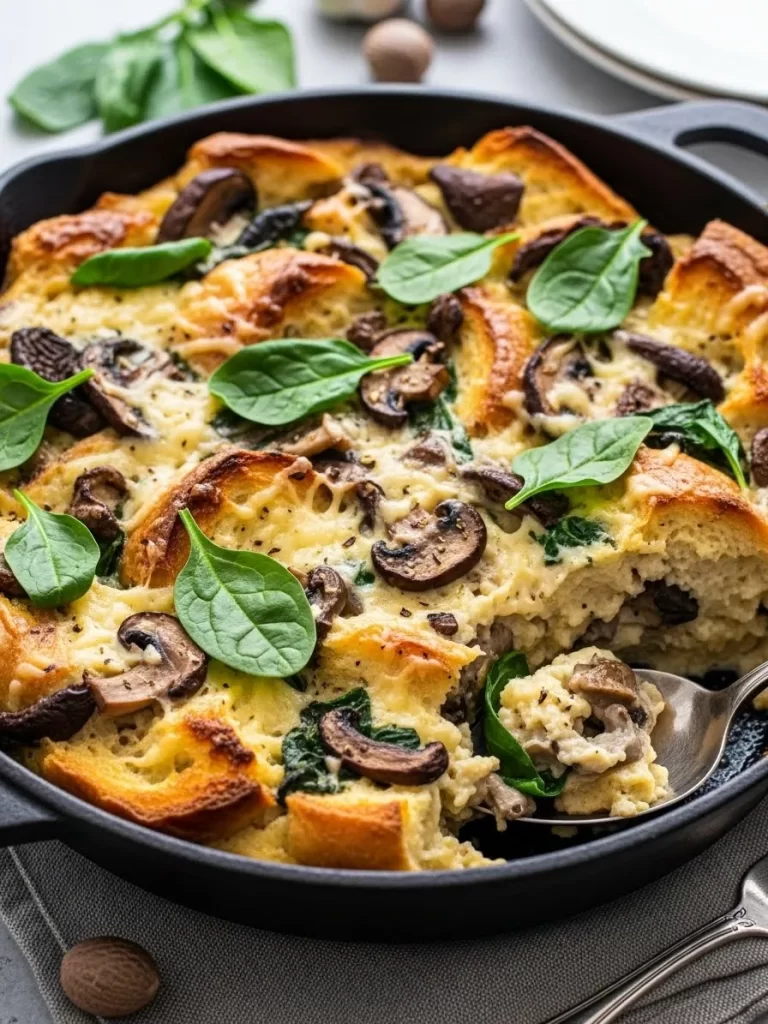
This deep-dish bake is a comforting, cheesy, and satisfying main course, resembling a rich savory bread pudding or strata. Served directly from a dark, rustic skillet, the dish boasts a beautiful golden-brown top.
Chunks of bread, likely brioche or sourdough, are visible, providing a soft, absorbent base that is generously soaked in a creamy, savory sauce. The top edges of the bread are lightly toasted, adding a pleasing chewiness.
Scattered throughout the dish are substantial pieces of earthy mushrooms, along with dark green, fresh spinach leaves, creating a vibrant color contrast. A blanket of melted cheese holds the entire dish together, promising a rich and decadent experience. A spoonful is already lifted out, showing the creamy texture ready to be enjoyed.
Required Ingredients
- 1 tablespoon olive oil or butter
- 1 medium yellow onion, chopped
- 1 pound mixed mushrooms (cremini, shiitake), sliced
- 3 cloves garlic, minced
- 5 oz fresh spinach
- 6 cups cubed day-old brioche or sourdough bread (about 1-inch cubes)
- 2 cups non-dairy or dairy heavy cream
- 1 cup vegetable broth
- 4 large eggs (or flax eggs/commercial egg replacer for vegan)
- 1 cup grated Gruyère, Swiss, or vegan mozzarella/cheddar cheese
- 1/2 teaspoon nutmeg
- Salt and black pepper to taste
Equipment List
- 10-inch oven-safe skillet (cast iron works well) or 9×13 inch baking dish
- Large bowl
- Whisk
- Cutting board and knife
DIY Instruction
Step 1: Prepare the Aromatics and Mushrooms
- Preheat your oven to 375°F (190°C). If using a baking dish, lightly grease it.
- Heat the oil or melt the butter in your skillet over medium heat. Add the chopped onion and cook for 5 minutes until soft.
- Add the sliced mushrooms to the skillet. Cook, stirring occasionally, until the mushrooms release their moisture and begin to brown nicely, about 8 to 10 minutes.
- Stir in the minced garlic and fresh spinach. Cook for just 2 minutes until the spinach wilts completely. Remove the skillet from the heat.
Step 2: Make the Custard Base
- In a large bowl, whisk together the cream, vegetable broth, eggs (or egg substitute), nutmeg, salt, and pepper until the mixture is smooth and well combined.
Step 3: Assemble the Bake
- If you are not using the skillet as the baking dish, transfer the mushroom and spinach mixture to the greased dish.
- Scatter the cubed bread evenly over the mushroom-spinach mixture.
- Pour the cream and egg custard mixture evenly over the bread and vegetables, ensuring all the bread cubes are saturated.
- Gently press the bread down with a spoon to help it absorb the liquid. Let the mixture rest for 10 minutes.
- Sprinkle the grated cheese evenly over the top of the entire bake.
Step 4: Bake and Serve
- Bake for 35 to 45 minutes, or until the custard is set, the bread is golden and puffed, and the cheese is melted and browned in spots.
- Allow the bake to cool slightly for 5 minutes before serving directly from the skillet or dish.
10. Mediterranean Artichoke, Bean, and Kale Loaf
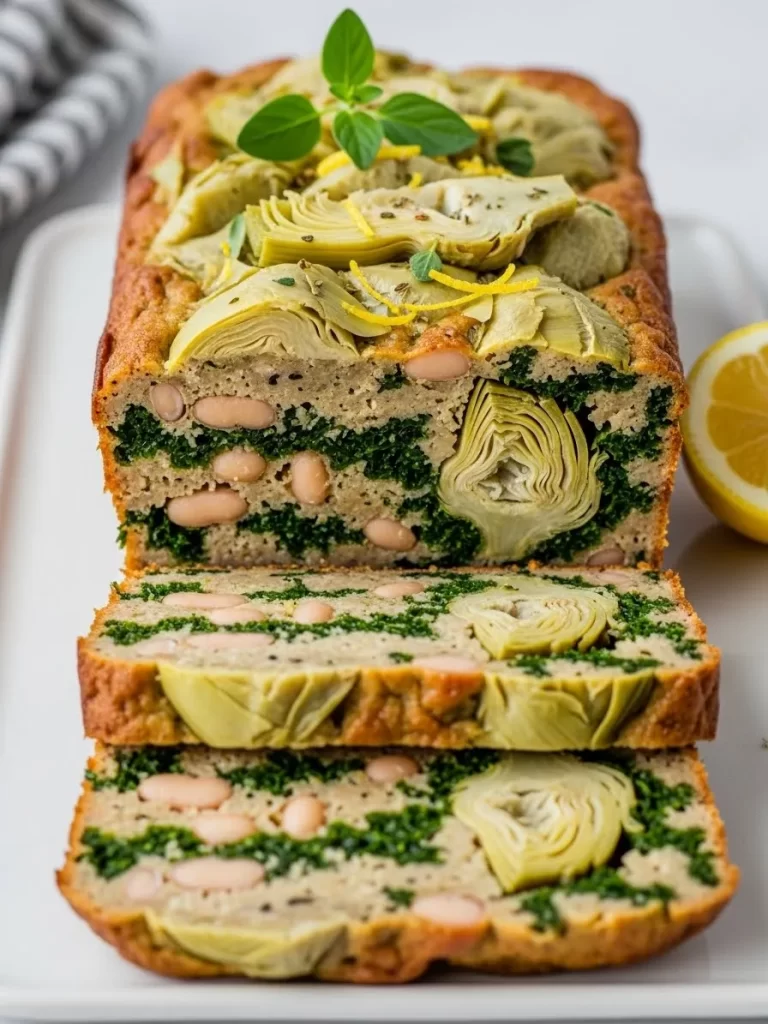
This vibrant loaf offers a fresh, bright alternative to heavier holiday mains, showcasing a beautiful, layered interior. Sliced thick and presented on a white platter, the loaf reveals its striking green and white pattern.
The exterior is baked to a pleasant golden brown, hinting at a crisp, herb-infused crust. The loaf itself is a savory blend of ground nuts or grains providing a hearty base. Running through the center is a continuous layer of bright, dark green kale or spinach, creating a beautiful visual contrast.
Nestled within the kale layer and throughout the loaf are creamy white cannellini beans, offering a subtle, soft texture. On top and visible in the cross-section are tender, whole marinated artichoke hearts, adding a tangy, briny flavor. A garnish of fresh oregano and lemon zest completes this elegant Mediterranean-inspired main.
Required Ingredients
- 1 tablespoon olive oil
- 1 medium yellow onion, finely chopped
- 3 cloves garlic, minced
- 1 cup raw cashews or almonds, finely ground
- 1 cup vegetable broth
- 1/2 cup breadcrumbs
- 1 tablespoon lemon zest, plus 2 tablespoons lemon juice
- 1 teaspoon dried oregano
- 1/2 teaspoon salt
- 1/4 teaspoon black pepper
- 1 (15-oz) can cannellini beans, rinsed and drained
- 5 oz kale or spinach, finely chopped
- 1 (13.75 oz) jar marinated artichoke hearts, drained (reserve 4-5 whole for topping)
Equipment List
- 9 x 5 inch loaf pan
- Parchment paper
- Food processor (for grinding nuts)
- Large skillet
- Mixing bowl
- Cutting board and knife
DIY Instruction
Step 1: Prepare the Base Mixture
- Preheat your oven to 375°F (190°C). Line a 9 x 5 inch loaf pan with parchment paper, leaving an overhang.
- Heat the olive oil in the large skillet over medium heat. Sauté the chopped onion for 5 minutes until soft. Add the minced garlic and cook for 1 minute until fragrant.
- In a large mixing bowl, combine the ground cashews/almonds, vegetable broth, breadcrumbs, lemon zest, lemon juice, dried oregano, salt, and pepper.
- Stir in the onion and garlic mixture. The base should be moist but firm.
Step 2: Combine the Layers
- Drain and rinse the cannellini beans. Add them to the mixing bowl.
- Add the finely chopped kale or spinach to the bowl. Stir everything together gently to distribute the beans and greens evenly throughout the base mixture.
- Roughly chop the remaining drained artichoke hearts (reserving 4-5 whole ones for the top). Stir these chopped hearts into the mixture.
Step 3: Form and Top the Loaf
- Transfer the entire mixture to the prepared loaf pan. Press the mixture down firmly and evenly to create a compact loaf.
- Arrange the 4 to 5 reserved whole artichoke hearts neatly on the top surface of the loaf.
- Sprinkle a small pinch of dried oregano and a little extra lemon zest over the artichoke hearts.
- Bake for 50 to 60 minutes, or until the top is golden brown and the loaf is firm to the touch.
Step 4: Finish and Serve
- Once baked, use the parchment paper overhang to lift the loaf out of the pan. Let it cool on a wire rack for at least 15 minutes before slicing. Cooling is important for the loaf to hold its shape.
- Serve the loaf sliced thick, perhaps with a side of lemon aioli or a balsamic reduction.
11. Creamy Leek and Goat Cheese Galette
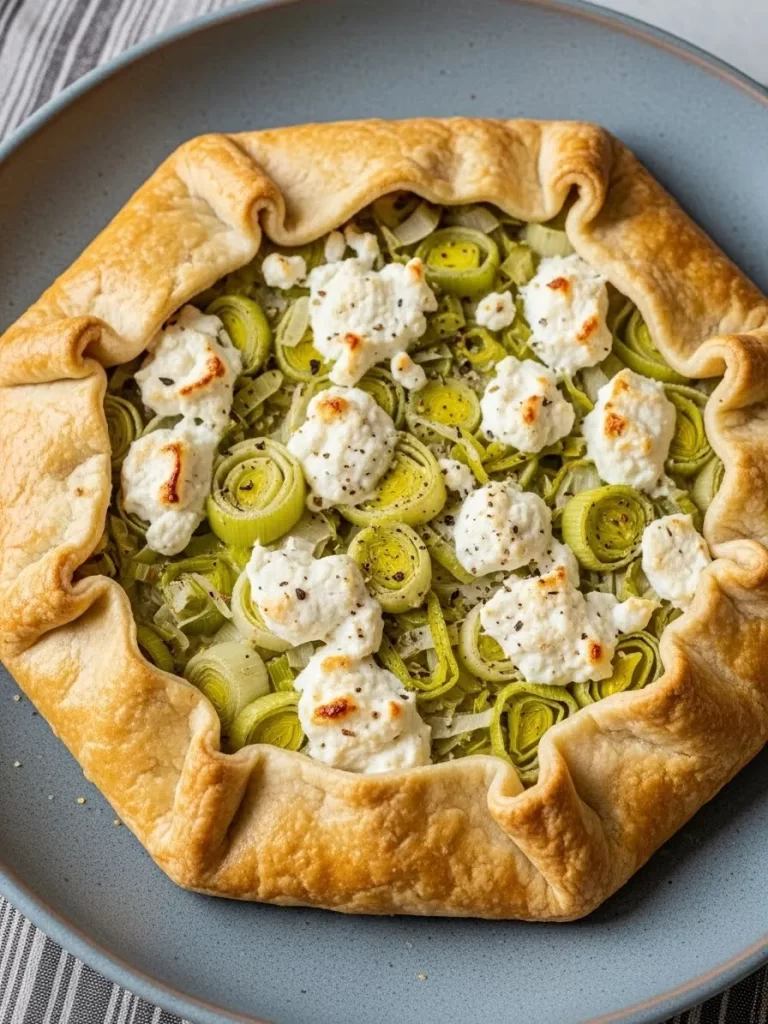
This rustic, free-form tart provides an elegant, yet approachable main dish that showcases the subtle, sweet flavor of leeks. The golden-brown crust is folded casually over the edges of the filling, lending the dish a charming, homemade appeal.
Inside the buttery crust sits a generous layer of tender, sautéed leeks, cut into delicate rings that form a lovely green pattern. The creamy filling rests on a bed of savory herbs, creating a flavorful and aromatic foundation.
Mounds of fresh goat cheese dot the top, contrasting beautifully with the bright green leeks. The cheese melts slightly during baking, adding a tangy, rich creaminess that balances the vegetable’s sweetness. This simple but visually pleasing galette makes a wonderful addition to any holiday table.
Required Ingredients
- 1 sheet ready-rolled pie dough or pastry (thawed)
- 3 tablespoons olive oil or butter
- 3 large leeks, white and light green parts only, thinly sliced and well rinsed
- 1 clove garlic, minced
- 1/2 teaspoon dried thyme
- 1/4 teaspoon salt
- Pinch of black pepper
- 4 oz goat cheese (chevre), crumbled or spooned in small dollops
- 1 egg (beaten, for egg wash) or non-dairy milk
Equipment List
- Baking sheet
- Parchment paper
- Large skillet
- Cutting board and sharp knife
- Pastry brush
DIY Instruction
Step 1: Prepare and Sauté the Leeks
- Preheat your oven to 400°F (200°C). Line a baking sheet with parchment paper.
- Thoroughly wash the sliced leeks to remove any trapped dirt or grit.
- Heat the olive oil or melt the butter in the large skillet over medium-low heat. Add the sliced leeks.
- Sauté the leeks gently for 10 to 12 minutes, stirring occasionally, until they are very soft and translucent. Avoid letting them brown too much; you want them tender and sweet.
- Stir in the minced garlic, dried thyme, salt, and pepper. Cook for 1 minute until fragrant. Remove the skillet from the heat and allow the mixture to cool slightly.
Step 2: Assemble the Galette
- Unroll the thawed pie dough onto the prepared baking sheet.
- Spread the cooled leek mixture evenly over the center of the dough, leaving a border of about 2 to 3 inches around the edges.
- Spoon the crumbled goat cheese in small, evenly spaced dollops over the top of the leek mixture.
- Carefully lift the edges of the dough and fold them up and over the filling, creating a free-form, rustic edge. The center filling should remain exposed.
Step 3: Bake the Galette
- Brush the folded pastry edges generously with the beaten egg or non-dairy milk wash. This gives the crust a beautiful golden color.
- Bake for 30 to 35 minutes, or until the pastry is deep golden brown and crisp, and the cheese is lightly melted and slightly browned in spots.
- Let the galette rest for 5 to 10 minutes before slicing and serving warm.
12. Sweet Potato and Root Vegetable Phyllo Pie
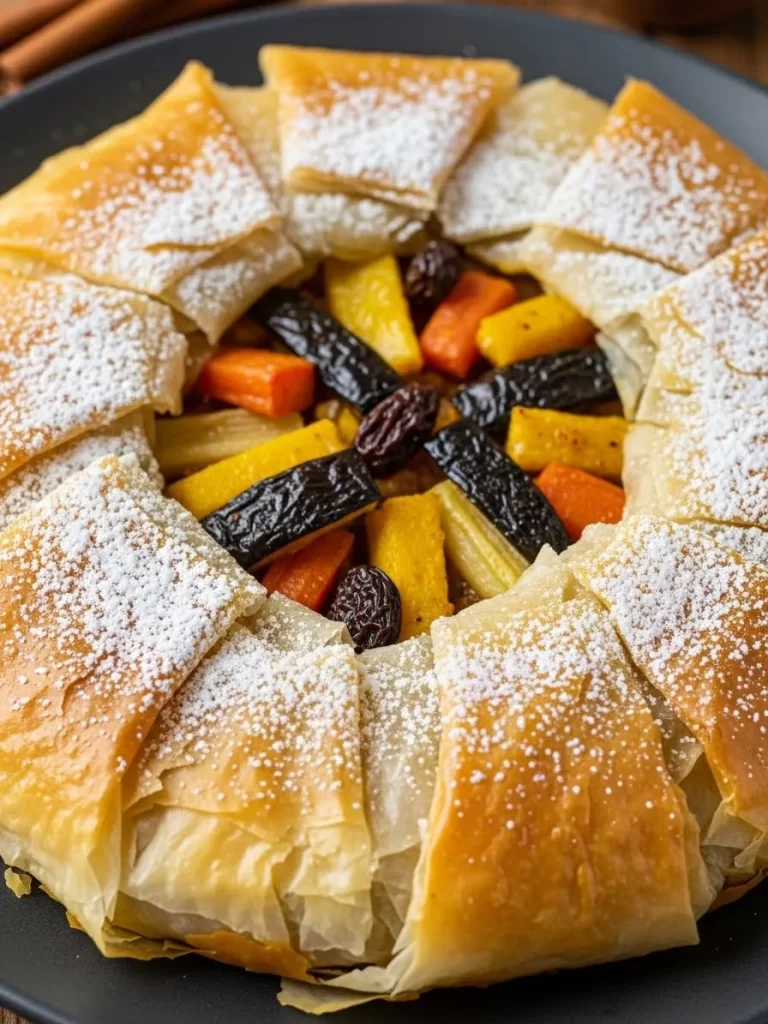
This visually engaging dish features an open center revealing a jewel-toned vegetable filling, framed by layers of delicate, golden pastry. The flaky phyllo crust is cut into neat triangles around the edge, resembling a festive wreath dusted lightly with snow.
The filling is a vibrant mix of colorful root vegetables, cut into similar-sized batons. Bright orange carrots, pale celery, and dark-skinned roasted sweet potato pieces create a medley of autumnal colors. Scattered among the vegetables are plump, dark raisins, hinting at a sweet and savory flavor profile.
A light dusting of powdered sugar over the phyllo crust offers a sweet contrast to the savory herbs and caramelized vegetables within. This beautiful pie is an elegant choice, combining crisp texture with tender, flavorful ingredients.
Required Ingredients
For the Filling:
- 2 tablespoons olive oil
- 1 medium sweet potato, peeled and cut into 1/2-inch batons
- 2 large carrots, peeled and cut into 1/2-inch batons
- 2 stalks celery, cut into 1/2-inch batons
- 1/2 cup pitted dates or raisins
- 1 teaspoon ground cumin
- 1/2 teaspoon ground cinnamon
- 1/2 teaspoon salt
- 1/4 teaspoon black pepper
- 1/4 cup vegetable broth
For the Crust:
- 8 sheets phyllo dough (thawed)
- 4 tablespoons melted butter or olive oil
- 1 tablespoon powdered sugar, for dusting
Equipment List
- Baking sheet
- Parchment paper
- Large skillet
- Cutting board and knife
- Pastry brush
- Small sieve (for dusting sugar)
DIY Instruction
Step 1: Roast and Season the Vegetables
- Preheat your oven to 375°F (190°C).
- Heat the olive oil in the large skillet over medium heat. Add the sweet potato, carrots, and celery batons.
- Sauté for about 10 minutes until the vegetables start to soften slightly.
- Add the dates or raisins, cumin, cinnamon, salt, and pepper. Stir well to coat the vegetables in the spices.
- Pour in the vegetable broth, bring to a quick simmer, and then remove from heat. The vegetables should be tender-crisp. Let the filling cool slightly.
Step 2: Prepare the Phyllo Base
- Lay a large sheet of parchment paper on your work surface. Place one sheet of phyllo dough on the paper and brush it lightly with melted butter or oil.
- Layer the remaining sheets one by one, brushing each layer with butter/oil.
- Place the vegetable filling mixture in the center of the layered phyllo, leaving a wide border of pastry all around (about 3-4 inches).
Step 3: Form the Pie
- Carefully fold the edges of the phyllo border up and over the edges of the filling, leaving the center exposed.
- Use scissors or a sharp knife to cut the outer, folded pastry edge into V-shaped pieces (triangles) that radiate outwards. Gently separate and space these cut pieces out slightly to resemble an open, festive crown.
- Brush the exposed pastry edges with any remaining butter/oil.
- Carefully transfer the pie on the parchment paper to the baking sheet.
Step 4: Bake and Finish
- Bake for 20 to 25 minutes, or until the phyllo crust is puffed, flaky, and a rich golden brown color.
- Remove from the oven and allow to cool for 5 minutes.
- Before serving, use a small sieve to dust the phyllo edges generously with powdered sugar for a snowy appearance.
13. Decadent Truffle and Wild Mushroom Pot Pies
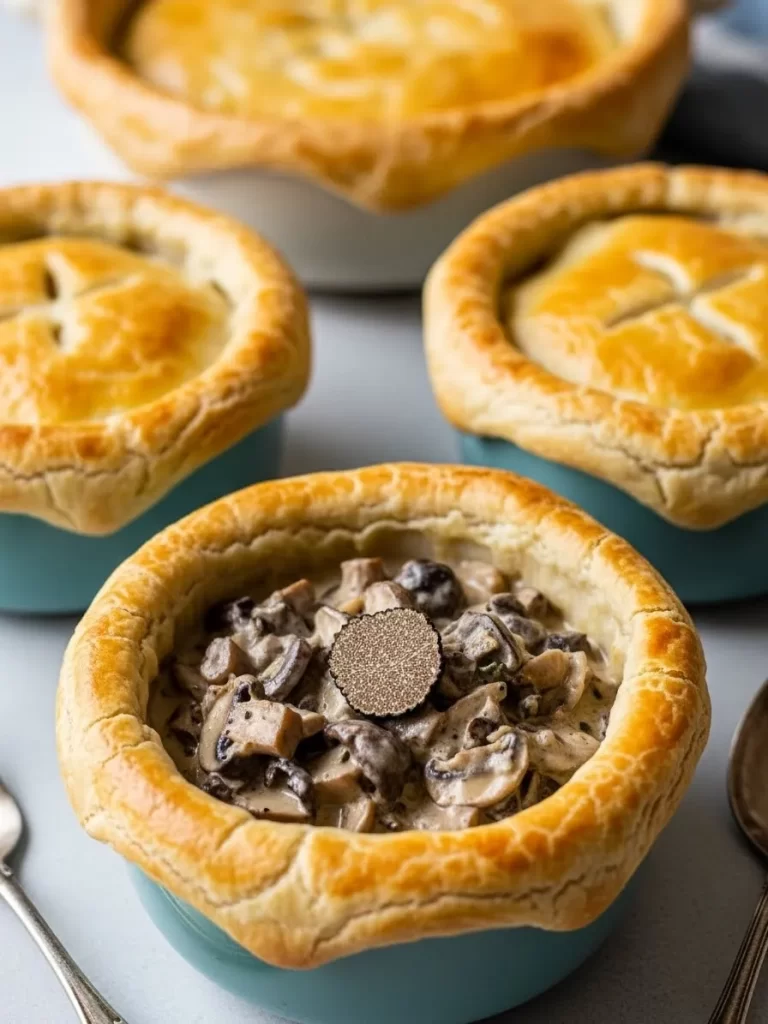
These individual pot pies offer a deeply savory and rich main course, presented in charming turquoise ceramic ramekins. The preparation allows for elegant individual servings, making them exceptionally appealing for a holiday meal.
A buttery, golden puff pastry crust seals the top of each ramekin. The pastry is lightly brushed, giving it a beautiful sheen and a few air vents cut into the top allow steam to escape.
The exposed filling in the foreground reveals a creamy, thick sauce packed with sliced mushrooms—likely a mix of cremini and wild varieties. A paper-thin slice of dark truffle rests prominently on the filling, suggesting a powerful, earthy aroma and luxurious flavor that elevates the simple pot pie to a gourmet experience.
Required Ingredients
- 1 tablespoon olive oil or butter
- 1 pound mixed mushrooms (cremini, shiitake, oyster), sliced
- 1 shallot, finely chopped
- 2 cloves garlic, minced
- 1/4 cup dry sherry or white wine (optional)
- 1/4 cup vegetable broth
- 1/2 cup non-dairy or dairy heavy cream
- 1 teaspoon fresh thyme leaves
- 1/2 teaspoon black truffle oil (optional, for intense flavor)
- Salt and black pepper to taste
- 1 sheet ready-rolled puff pastry (thawed)
- 1 egg (beaten, for egg wash)
- Fresh black truffle slices, for garnish (optional)
Equipment List
- 4 individual oven-safe ramekins (about 8-10 oz capacity)
- Large skillet
- Cutting board and knife
- Pastry brush
- Cookie cutter or knife
DIY Instruction
Step 1: Prepare the Mushroom Filling
- Preheat your oven to 400°F (200°C).
- Heat the olive oil or melt the butter in the large skillet over medium-high heat. Add the sliced mushrooms and shallot. Cook, stirring occasionally, until the mushrooms have released their moisture and browned nicely, about 8 to 10 minutes.
- Stir in the minced garlic and cook for 1 minute until fragrant.
- If using, pour in the sherry or white wine and scrape up any browned bits from the bottom of the pan. Let the liquid reduce by half.
- Stir in the vegetable broth and heavy cream. Bring the mixture to a simmer. Reduce the heat and stir in the fresh thyme, truffle oil, salt, and pepper. Simmer for 5 minutes until the sauce thickens slightly.
Step 2: Fill and Top the Ramekins
- Spoon the creamy mushroom mixture evenly into the four individual ramekins.
- Lay the puff pastry sheet flat. Use a large cookie cutter or knife to cut out four circles slightly larger than the diameter of your ramekins.
- Place one pastry circle over the top of each filled ramekin, pressing the edges firmly against the rim to seal.
- Use a sharp knife to cut a small ‘X’ or ‘V’ shape in the center of each pastry top to allow steam to escape.
Step 3: Bake the Pot Pies
- Brush the top of each puff pastry crust with the beaten egg wash.
- Place the ramekins on a baking sheet (to catch any spills).
- Bake for 18 to 20 minutes, or until the puff pastry is fully risen, golden brown, and flaky.
- Allow the pot pies to cool for a couple of minutes before serving. If using, place a thin slice of fresh truffle on top of the exposed filling in the center cut before serving.
14. Butternut Squash and Ricotta Quiche
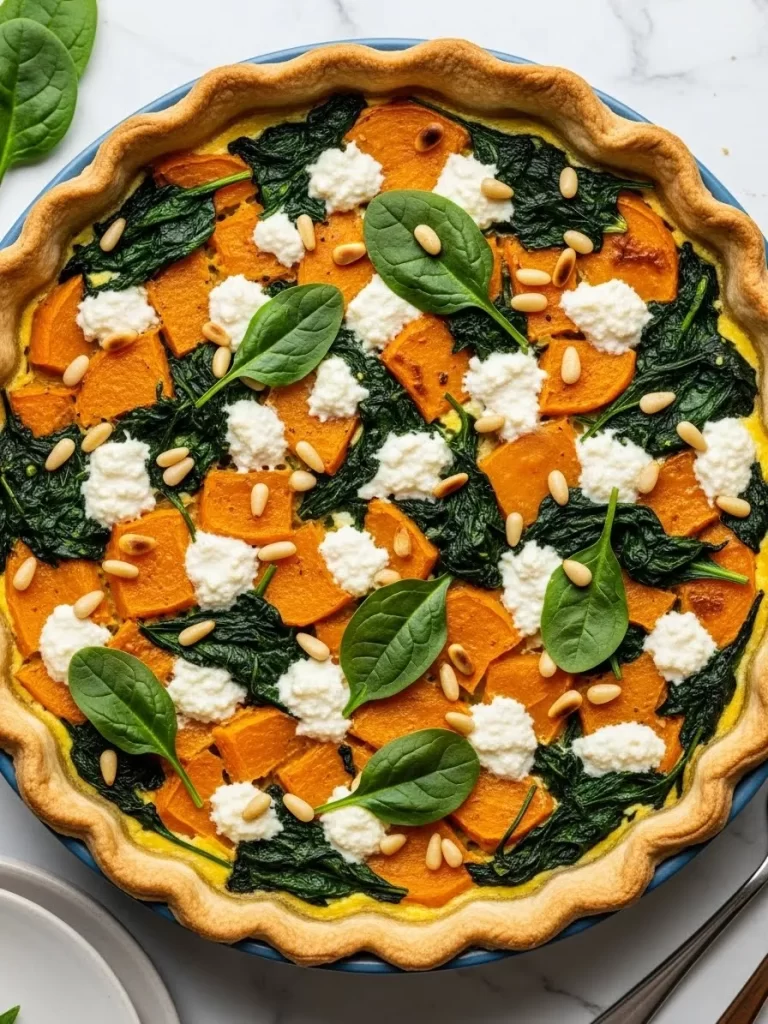
This vibrant and appealing quiche features a beautiful geometric arrangement of colors, making it a spectacular main dish. The golden pastry crust is deeply crimped, holding a rich and colorful egg custard filling.
The surface of the filling displays a delightful mosaic of seasonal ingredients. Tender, roasted butternut squash cubes, bright orange in color, are laid out in a repeating pattern. The squash is set against rich, dark green sautéed spinach, creating striking contrasts.
Small dollops of creamy white ricotta or goat cheese are scattered across the top, adding a lovely texture and tang. A sprinkle of pine nuts completes the arrangement, lending a buttery crunch. This quiche is both substantial and elegant, truly a satisfying vegetarian centerpiece.
Required Ingredients
For the Filling:
- 1 sheet ready-rolled shortcrust pastry (thawed)
- 1 cup butternut squash, peeled and cubed (roasted or boiled until tender)
- 1 tablespoon olive oil
- 5 oz fresh spinach
- 1/2 teaspoon dried sage
- 1/2 cup ricotta cheese (dairy or vegan alternative)
- 4 large eggs (or equivalent vegan egg replacer)
- 1 cup non-dairy or dairy milk
- 1/4 cup grated cheese (Gruyère or vegan blend, optional)
- Salt and black pepper to taste
- 2 tablespoons pine nuts, lightly toasted
Equipment List
- 9-inch quiche or pie pan
- Rolling pin (if needed)
- Large skillet
- Large mixing bowl
- Whisk
- Cutting board and knife
DIY Instruction
Step 1: Prepare the Crust and Vegetables
- Preheat your oven to 375°F (190°C). Gently press the thawed pastry into the quiche or pie pan and crimp the edges neatly. Prick the bottom lightly with a fork.
- Bake the crust “blind” for 10 minutes. Remove and set aside.
- Heat the olive oil in the large skillet over medium heat. Add the spinach and sauté quickly until it wilts completely. Stir in the dried sage, then squeeze out as much excess moisture as possible from the spinach.
- In the pre-baked crust, arrange the roasted butternut squash cubes and the sautéed spinach in an appealing, alternating pattern.
Step 2: Create the Custard and Assemble
- In the large mixing bowl, whisk together the eggs (or replacer) and milk until smooth. Stir in the grated cheese (if using), salt, and pepper.
- Carefully pour the egg custard mixture over the vegetables in the crust.
- Spoon the ricotta cheese in small dollops evenly over the top of the filling.
Step 3: Bake and Garnish
- Bake the quiche for 40 to 45 minutes, or until the custard is set (a knife inserted near the center comes out clean) and the top is golden.
- Remove from the oven and allow the quiche to cool for 10 minutes before slicing.
- Garnish the top with the toasted pine nuts and a few fresh spinach leaves just before serving.
15. Lemon Dill and Feta Filo Pie
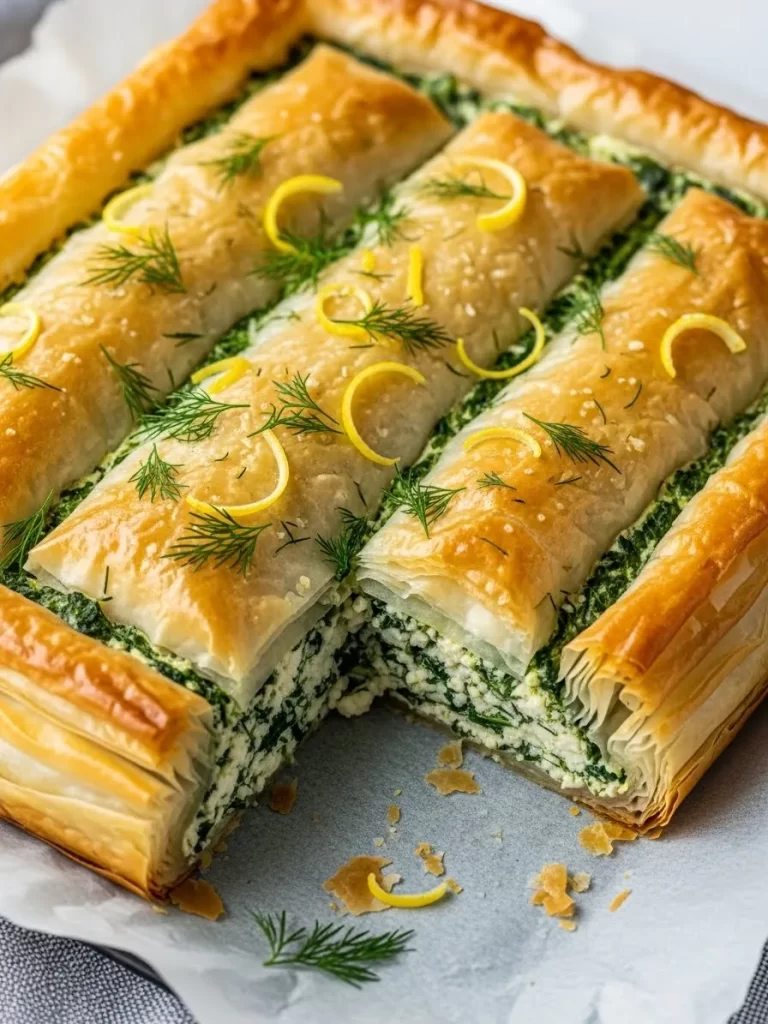
This savory pie offers a beautifully segmented presentation, showcasing rich, creamy pockets of filling framed by crisp, golden phyllo pastry. The rectangular shape makes it easy to slice and serve for a larger gathering.
Layers of delicate, flaky phyllo are brushed and baked to a stunning honey-gold color. They create a contrast in texture between the shatteringly crisp exterior and the soft interior. The pie is artfully constructed with channels of creamy green filling showing between the pastry segments.
The filling is a rich, herby mixture, likely made with spinach, ricotta, and feta cheese, giving it a savory, salty tang. A generous scattering of fresh dill and delicate curls of lemon zest across the top elevate the dish, adding a bright, aromatic finish.
Required Ingredients
- 1 package phyllo pastry (thawed)
- 1 stick (1/2 cup) butter, melted, or 1/2 cup olive oil
- 10 oz frozen chopped spinach, thawed and squeezed very dry
- 1 cup ricotta cheese (dairy or vegan alternative)
- 4 oz feta cheese, crumbled
- 1/4 cup fresh dill, chopped, plus extra for garnish
- 1 tablespoon fresh lemon juice
- Zest of 1 lemon, plus peels for garnish
- 1 egg (beaten, for binding, optional)
- 1/4 teaspoon nutmeg
- Salt and black pepper to taste
Equipment List
- 9 x 13 inch baking dish
- Small bowl
- Pastry brush
- Mixing bowl
DIY Instruction
Step 1: Prepare the Filling
- Preheat your oven to 375°F (190°C).
- In a large mixing bowl, combine the thoroughly squeezed spinach, ricotta cheese, crumbled feta, chopped fresh dill, lemon juice, lemon zest, egg (if using), nutmeg, salt, and pepper. Mix until the filling is uniform and well combined.
Step 2: Layer the Filo
- Brush the bottom of the 9 x 13 inch baking dish with melted butter or oil.
- Lay half of the phyllo sheets, one at a time, into the dish, brushing each layer generously with butter or oil before adding the next. Ensure the phyllo drapes up the sides of the dish.
- Spread the creamy spinach-feta mixture evenly over the phyllo base.
Step 3: Seal and Segment the Pie
- Top the filling with the remaining half of the phyllo sheets, brushing each layer thoroughly with butter or oil.
- Tuck the overhanging phyllo edges down around the sides of the dish to create a neat, thick crust.
- Before baking, use a sharp knife to lightly cut the top layers of phyllo into three long, even strips, going only halfway down to the filling. This creates the segmented look and makes slicing easier later.
Step 4: Bake and Finish
- Bake for 30 to 40 minutes, or until the top is deeply golden brown and the pie is firm.
- Allow the pie to cool for 10 minutes before slicing all the way through the pre-cut lines.
- Garnish the top with the extra fresh dill sprigs and lemon zest curls before serving.
16. Festive Sunburst Stuffed Shells
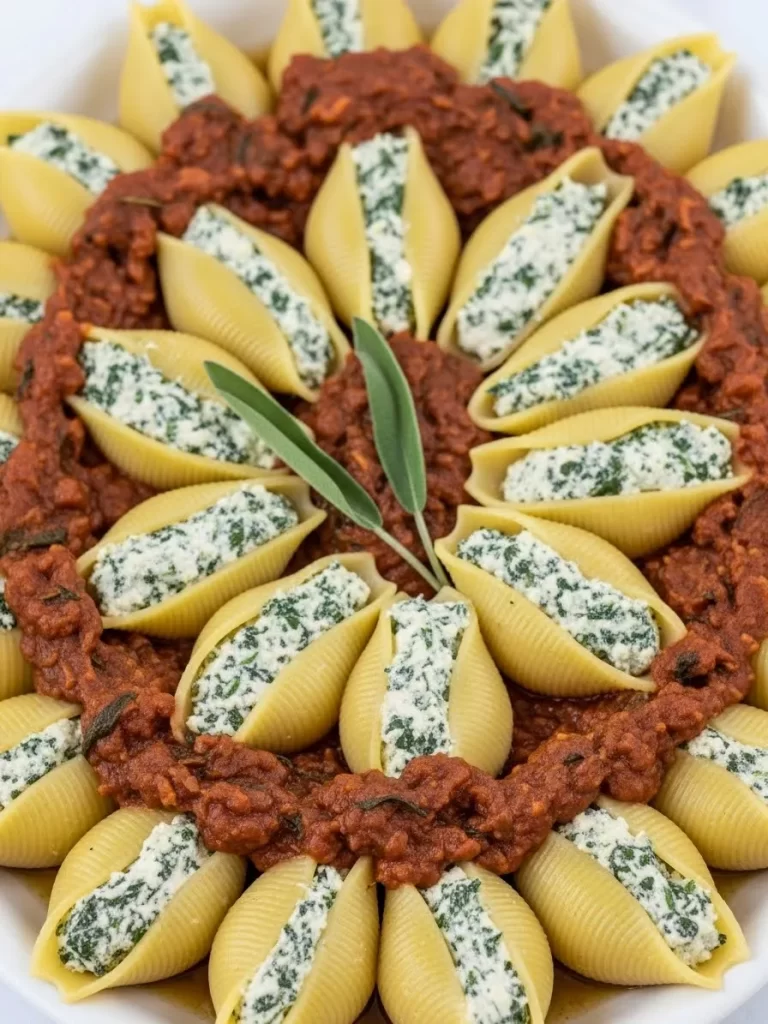
This stunning presentation transforms traditional baked pasta into an artful holiday centerpiece. Large, cooked jumbo pasta shells are arranged in a beautiful circular “sunburst” pattern around a central well of savory red sauce.
Each large shell is generously filled with a creamy, herbed ricotta or cheese mixture combined with finely chopped spinach or other greens. The filling stands out brightly against the pasta, adding a pleasant color contrast.
The shells are nestled snugly in a rich, deeply flavored tomato and herb sauce that has been spooned onto the platter. A few fresh sage leaves are placed in the center of the sauce, adding a beautiful aromatic garnish that signals the savory nature of the dish. This is a wonderfully hearty and impressive main course.
Required Ingredients
- 24 jumbo pasta shells
- 1 tablespoon olive oil
- 1/2 large onion, diced
- 2 cloves garlic, minced
- 1 (28 oz) can crushed tomatoes
- 1 teaspoon dried oregano
- 1 teaspoon dried basil
- Salt and black pepper to taste
For the Filling:
- 15 oz ricotta cheese (dairy or vegan alternative)
- 10 oz frozen chopped spinach, thawed and squeezed very dry
- 1/2 cup grated Parmesan or vegan cheese alternative
- 1 egg (beaten, for binding, optional)
- 1/4 teaspoon nutmeg
Equipment List
- Large pot
- 9 x 13 inch baking dish (or large round platter for presentation)
- Large skillet
- Mixing bowl
- Spoon or piping bag
DIY Instruction
Step 1: Cook Pasta and Prepare Sauce
- Cook the jumbo pasta shells according to package directions until they are al dente. Drain the shells and rinse them gently with cool water to prevent sticking.
- While the shells cook, prepare the sauce. Heat the olive oil in a large skillet over medium heat. Add the diced onion and cook for 5 minutes until soft.
- Stir in the minced garlic and cook for 1 minute.
- Add the crushed tomatoes, oregano, and basil. Season with salt and pepper. Bring the sauce to a simmer, then reduce heat and let it gently bubble for 15 minutes.
Step 2: Create the Filling
- In a mixing bowl, combine the ricotta cheese, thoroughly squeezed spinach, grated Parmesan, beaten egg (if using), nutmeg, salt, and pepper. Mix until the filling is creamy and uniform.
- Carefully fill each cooked jumbo shell with a generous amount of the ricotta mixture, using a spoon or piping bag.
Step 3: Assemble and Bake
- Preheat your oven to 375°F (190°C).
- Spread about two-thirds of the prepared tomato sauce evenly across the bottom of the 9 x 13 inch baking dish.
- Arrange the filled shells, open side up, in the sauce. For a sunburst effect, use a large, round serving platter, spoon the sauce into a central ring, and arrange the shells radiating outward.
- Spoon the remaining sauce lightly over the shells (or only into the center if arranging on a platter).
- Cover the dish with foil and bake for 20 to 25 minutes, or until the sauce is bubbly and the filling is heated through. If you desire browning, remove the foil for the last 5 minutes.
- Garnish with fresh sage leaves before serving.
17. Asparagus and Black Truffle Risotto
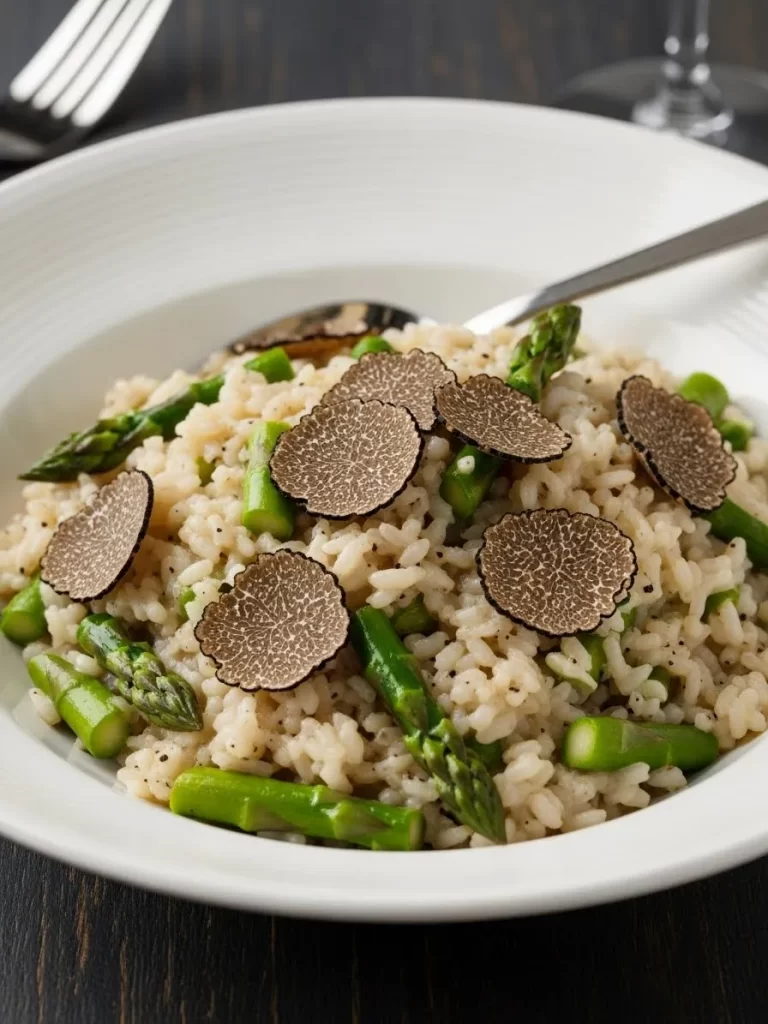
This luxurious dish presents a creamy, elegant main course, offering sophisticated flavors and a restaurant-worthy presentation. The pale, creamy risotto is served in a wide white bowl, providing a beautiful canvas for the toppings.
The rice is perfectly cooked, achieving that signature creamy texture characteristic of authentic risotto. Mixed throughout the grains are vibrant chunks of bright green asparagus, adding a fresh, slightly crunchy texture and a welcome spring color.
The dish is elevated by thin, dark shavings of black truffle, artfully scattered over the top. The truffle provides an intense, earthy aroma and rich flavor that signals true indulgence, making this a spectacular vegetarian offering for any formal holiday event.
Required Ingredients
- 6 cups hot vegetable broth
- 1 tablespoon olive oil
- 1 small yellow onion, finely minced
- 1 1/2 cups Arborio rice
- 1/2 cup dry white wine
- 1 bunch fresh asparagus, trimmed and cut into 1-inch pieces
- 1/2 cup grated Parmesan or vegan cheese alternative
- 2 tablespoons non-dairy or dairy butter
- Salt and black pepper to taste
- 1/2 teaspoon truffle oil (optional, for flavor boost)
- Black truffle shavings (optional, for garnish)
Equipment List
- Medium saucepan
- Large, heavy-bottomed pot or Dutch oven
- Wooden spoon or spatula
- Cutting board and knife
DIY Instruction
Step 1: Prepare Broth and Sauté Aromatics
- In the medium saucepan, bring the vegetable broth to a simmer and keep it hot over low heat throughout the process.
- Heat the olive oil in the large pot over medium heat. Add the minced onion and cook for 5 to 7 minutes until soft and translucent. Do not allow it to brown.
- Add the Arborio rice to the pot and toast, stirring constantly, for 2 minutes until the edges of the grains become translucent.
Step 2: Deglaze and Cook the Risotto
- Pour the white wine into the pot. Stir constantly until the wine is completely absorbed by the rice.
- Add one ladleful (about 1/2 cup) of the hot broth to the rice. Stir constantly until the liquid is almost completely absorbed.
- Continue this process, adding one ladleful of broth at a time and stirring until absorbed, for about 15 minutes.
- After about 15 minutes (when the rice is still slightly chewy), stir in the cut asparagus pieces. Continue adding broth and stirring until the rice is tender but still has a slight bite (al dente). This whole process takes about 20 to 25 minutes.
Step 3: Finish and Serve (Mantecaura)
- Remove the pot from the heat. Stir in the butter, Parmesan/vegan cheese, salt, pepper, and truffle oil (if using). Stir vigorously for 1 minute; this process is called mantecaura and makes the risotto incredibly creamy.
- Serve the risotto immediately in warm bowls.
- Garnish each serving with fresh black truffle shavings, if desired, right before presenting.
18. Elegant Stuffed Lasagna Rolls
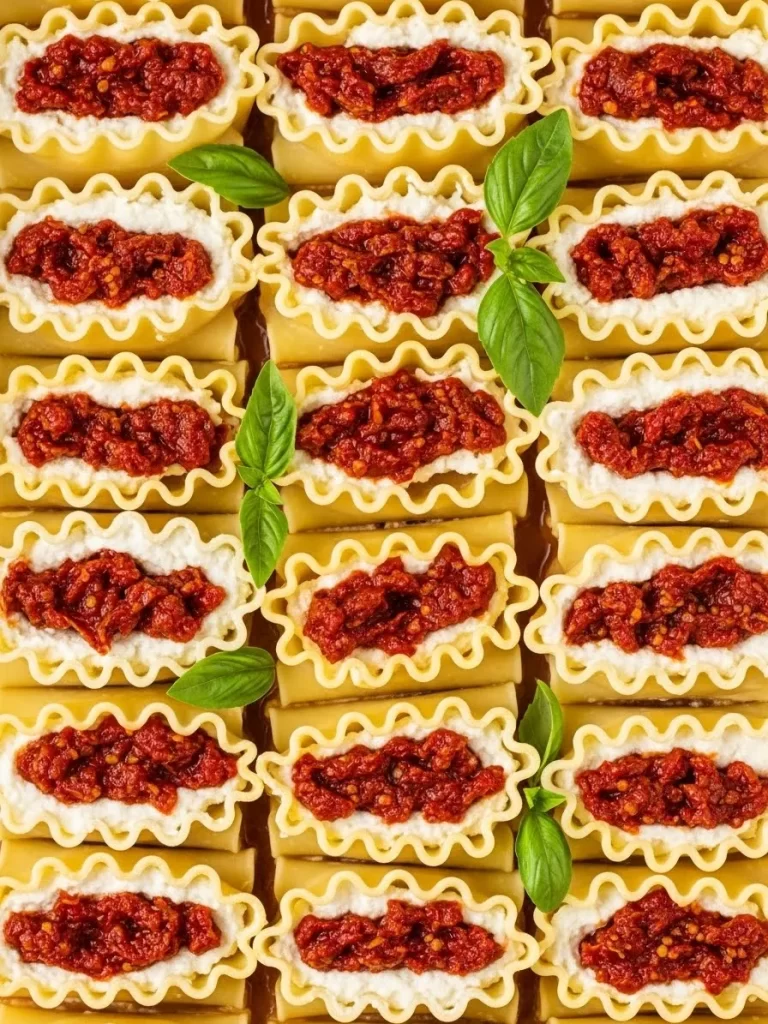
These individually rolled lasagna noodles offer an exceptionally clean and appetizing presentation, transforming a classic casserole into a neat, refined main dish. The rolls are arranged side-by-side, creating a beautiful pattern of pasta ridges and colorful filling.
Each cooked lasagna noodle is generously filled with a creamy white cheese mixture, likely ricotta seasoned with herbs, visible in the open-faced center of the roll. This soft, white filling is topped with a spoonful of rich, chunky red marinara or Bolognese sauce.
The contrast between the bright red sauce, the creamy white filling, and the pale yellow, ruffled edges of the pasta is visually delightful. A single, fresh basil leaf garnishes each roll, adding a vibrant green accent and a fragrant herbal note to the top.
Required Ingredients
- 12 lasagna noodles
- 1 tablespoon olive oil
- 1 small onion, diced
- 2 cloves garlic, minced
- 1 (28 oz) can crushed tomatoes
- 1 teaspoon dried oregano
- 1/2 teaspoon salt
- 1/4 teaspoon black pepper
For the Filling:
- 15 oz ricotta cheese (dairy or vegan alternative)
- 1 cup fresh spinach, finely chopped (optional)
- 1/2 cup grated Parmesan or vegan cheese alternative
- 1 egg (beaten, for binding, optional)
- Fresh basil leaves, for garnish
Equipment List
- Large pot
- 9 x 13 inch baking dish (or smaller pan for rolling)
- Large skillet
- Mixing bowl
- Cutting board and knife
DIY Instruction
Step 1: Cook Pasta and Sauce
- Cook the lasagna noodles according to package directions until they are al dente (slightly firm). Drain them and lay them flat on a piece of parchment paper to cool slightly and prevent sticking.
- While the noodles cook, prepare the sauce. Heat the olive oil in a large skillet over medium heat. Sauté the diced onion for 5 minutes until soft.
- Stir in the minced garlic and cook for 1 minute. Add the crushed tomatoes, oregano, salt, and pepper. Simmer the sauce gently for 15 minutes.
Step 2: Prepare the Filling
- In a mixing bowl, combine the ricotta cheese, chopped spinach (if using), grated cheese, beaten egg (if using), salt, and pepper. Mix until the filling is smooth and uniform.
Step 3: Assemble the Rolls
- Preheat your oven to 375°F (190°C). Spread a thin layer of sauce on the bottom of your baking dish.
- Lay one cooked lasagna noodle flat. Spread a thin layer of the ricotta filling evenly over the entire surface of the noodle.
- Starting from one short end, carefully roll the noodle into a tight spiral.
- Place the rolled lasagna seam-side down in the prepared baking dish. Repeat with the remaining noodles, arranging them snugly in the dish.
Step 4: Bake and Garnish
- Spoon the remaining tomato sauce evenly over the tops of the rolls.
- Cover the dish loosely with aluminum foil. Bake for 25 to 30 minutes, or until the rolls are heated through and the sauce is bubbly.
- For a browned top, remove the foil for the last 5 minutes.
- Garnish the top of each roll with a spoonful of extra tomato sauce and a fresh basil leaf just before serving.
19. Creamy Polenta with Sautéed Mushrooms and Brussels Sprouts
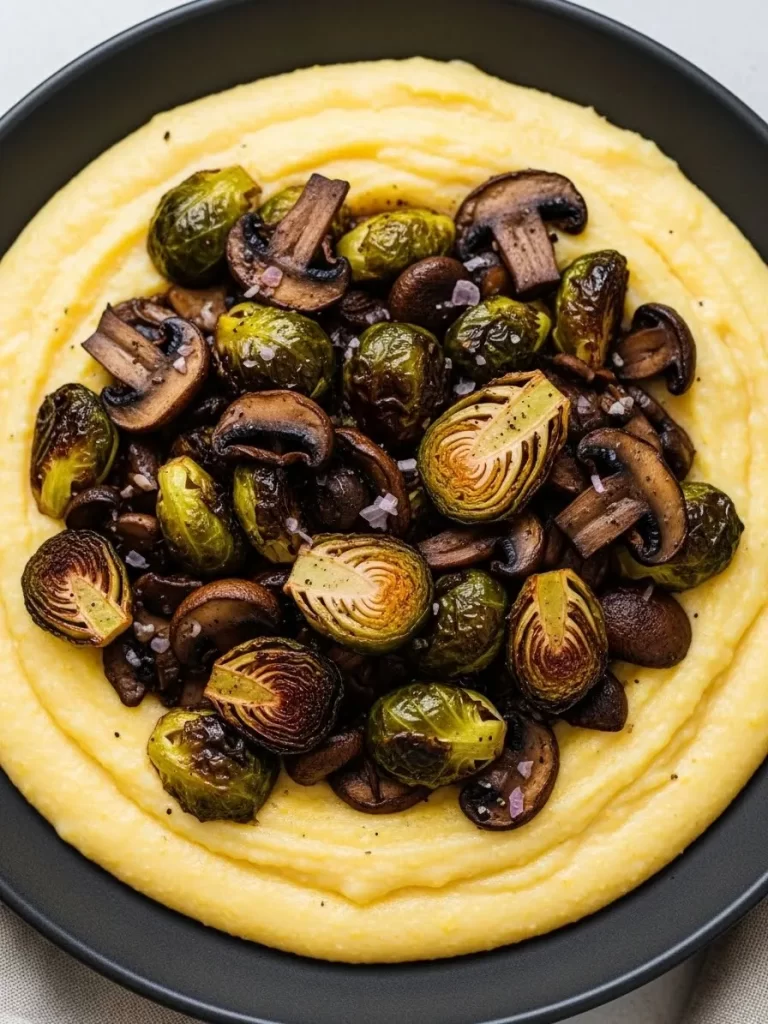
This deeply comforting and rustic dish offers a hearty and simple main course, presenting a beautiful contrast in color and texture. A bed of bright, creamy yellow polenta is generously mounded with savory toppings, served in a dark, shallow bowl.
The polenta base is cooked until silky and smooth, radiating outward to form a neat circle on the plate. It provides a warm, mild foundation for the strong, earthy flavors placed on top.
Piled high in the center is a mixture of darkly caramelized Brussels sprouts and sliced mushrooms. The sprouts are halved and roasted until deeply browned and tender, while the mushrooms add a rich, umami flavor. A sprinkle of sea salt flakes adds a beautiful, subtle sparkle to the deeply colored vegetables.
Required Ingredients
For the Polenta:
- 4 cups vegetable broth or water
- 1 cup coarse or quick-cooking cornmeal (polenta)
- 1/2 cup grated Parmesan or vegan cheese alternative
- 2 tablespoons butter or olive oil
- 1/2 teaspoon salt
For the Topping:
- 2 tablespoons olive oil
- 1 pound Brussels sprouts, trimmed and halved
- 8 oz cremini or button mushrooms, sliced
- 1 clove garlic, minced (optional)
- Salt and black pepper to taste
Equipment List
- Medium saucepan (for polenta)
- Large skillet (for vegetables)
- Wooden spoon or whisk
- Serving bowls
DIY Instruction
Step 1: Cook the Polenta
- Bring the vegetable broth or water to a boil in the saucepan. Add the salt.
- Slowly whisk in the cornmeal (polenta) in a steady stream to prevent lumps.
- Reduce the heat to low and continue stirring, scraping the bottom of the pan, until the polenta thickens. This takes about 5 to 7 minutes for quick-cooking cornmeal, or 30 to 40 minutes for coarse cornmeal.
- Remove from heat and stir in the Parmesan/vegan cheese and butter/oil until the polenta is smooth and creamy. Keep warm.
Step 2: Sauté the Toppings
- Heat the olive oil in the large skillet over medium-high heat. Add the halved Brussels sprouts cut-side down.
- Cook, undisturbed, for 5 minutes until they begin to brown and caramelize nicely. Stir and continue cooking for 3 minutes.
- Add the sliced mushrooms and cook for another 5 to 7 minutes until the mushrooms are tender and browned.
- Stir in the minced garlic (if using), salt, and pepper. Cook for 1 minute until fragrant.
Step 3: Serve
- Spoon the creamy polenta into individual bowls, forming a shallow well in the center.
- Spoon a generous amount of the hot, savory mushroom and Brussels sprout mixture directly over the polenta.
- Serve immediately while the polenta is still soft and flowing.
20. Creamy Baked Gnocchi with Butternut Squash and Sage
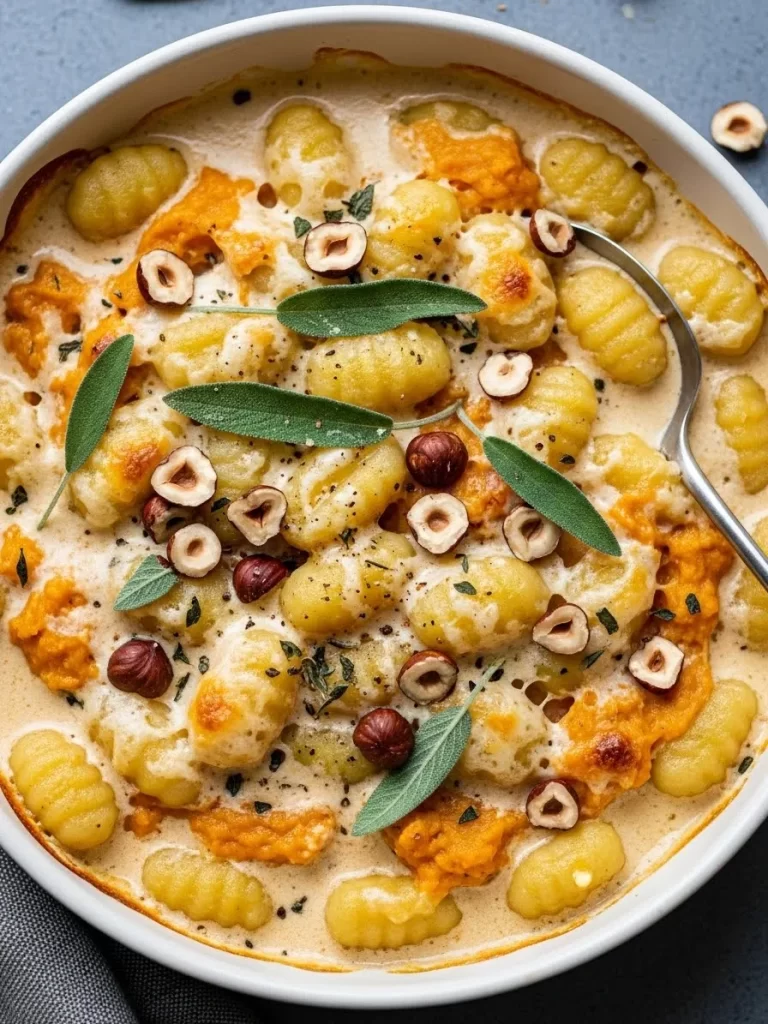
This incredibly rich and comforting dish features tender potato gnocchi baked in a luxurious, creamy sauce. Served hot from a white baking dish, the top has light golden-brown patches where the cheese has caramelized.
The sauce is a delightful combination of sweet butternut squash puree, providing a beautiful orange swirl throughout the pale cream. The soft gnocchi pillows are perfectly cooked, capturing the sauce in their grooves.
Fresh sage leaves and toasted hazelnuts are scattered over the top, adding a lovely herbal aroma and a satisfying crunch. The sage is essential for bringing out the autumnal flavors of the squash, creating a truly warming and celebratory dish.
Required Ingredients
- 1 pound potato gnocchi (store-bought or homemade)
- 1 tablespoon olive oil
- 1/2 small onion, finely chopped
- 1 cup butternut squash puree (canned or roasted)
- 1 cup non-dairy or dairy heavy cream
- 1/2 cup vegetable broth
- 1/2 cup grated Gruyère, Swiss, or vegan cheese blend, plus extra for topping
- 1 teaspoon fresh thyme leaves
- 1/2 teaspoon salt
- 1/4 teaspoon black pepper
- 1/4 cup toasted hazelnuts, roughly chopped
- 8 to 10 fresh sage leaves
Equipment List
- Large pot
- Large skillet
- 8-inch square baking dish or round casserole dish
- Cutting board and knife
DIY Instruction
Step 1: Cook Gnocchi and Prepare Sauce Base
- Preheat your oven to 400°F (200°C). Lightly grease your baking dish.
- Bring a large pot of salted water to a boil. Add the gnocchi and cook until they float to the surface (about 2 to 3 minutes). Drain the gnocchi immediately.
- Heat the olive oil in the large skillet over medium heat. Add the chopped onion and cook for 5 minutes until softened.
Step 2: Assemble the Creamy Sauce
- Stir the butternut squash puree, heavy cream, vegetable broth, thyme, salt, and pepper into the skillet with the onions. Bring the mixture to a gentle simmer.
- Reduce the heat to low and stir in the grated cheese until the sauce is smooth.
Step 3: Bake the Dish
- Gently fold the cooked gnocchi into the creamy butternut squash sauce until everything is evenly coated.
- Pour the entire mixture into the prepared baking dish.
- Scatter a small amount of extra grated cheese over the top for browning.
- Bake for 15 to 20 minutes, or until the sauce is bubbling and the top is lightly golden brown.
Step 4: Garnish and Serve
- While the gnocchi bakes, quickly toast the sage leaves in a separate small, oiled pan until crisp (if desired).
- Remove the dish from the oven. Scatter the chopped toasted hazelnuts and the fresh or crisped sage leaves over the top.
- Serve immediately with a spoon for scooping out the rich, creamy portions.
21. Spicy Thai Red Curry with Tofu and Lemongrass

This rich, aromatic dish brings bright, exciting flavors to the holiday table, offering a lighter alternative to traditional heavy fare. Served in a wide, pale bowl, the vibrant orange curry is creamy and visually stunning.
The deep sauce, likely made with coconut milk and red curry paste, contains substantial cubes of golden, fried tofu, absorbing the complex spices beautifully. Thinly sliced onions and chunks of jackfruit or mushrooms add texture and body.
The dish is dramatically garnished with traditional Thai aromatics, including bright red chili slices, thin spirals of lemongrass, and fresh lime leaves. A bright silver spoon rests in the curry, ready to scoop up this comforting, savory main. This curry is a beautiful blend of spicy, sweet, and sour notes.
Required Ingredients
- 1 tablespoon coconut oil
- 1 block (14-16 oz) extra-firm tofu, pressed and cubed
- 1 medium yellow onion, sliced
- 1/2 cup jackfruit, canned and drained (optional)
- 4 cloves garlic, minced
- 1 (14 oz) can full-fat coconut milk
- 2 tablespoons red curry paste (adjust to preferred spice level)
- 1 cup vegetable broth
- 1 tablespoon brown sugar or maple syrup
- 1 tablespoon soy sauce or tamari
- 1 stalk lemongrass, bruised and cut into 3-inch pieces
- 4 kaffir lime leaves (or a few lime zest strips)
- Fresh lime juice, to taste
- Sliced red chili and cilantro, for garnish
Equipment List
- Large wok or deep pot
- Cutting board and knife
- Measuring cups and spoons
DIY Instruction
Step 1: Cook the Tofu
- Press the tofu block for at least 30 minutes to remove excess water. Cut it into 1-inch cubes.
- Heat a small amount of oil in a skillet and pan-fry the tofu cubes until golden brown and slightly crispy on all sides. Set the tofu aside.
Step 2: Build the Curry Base
- Add the coconut oil to the large wok or deep pot over medium heat. Add the sliced onion and sauté for 5 minutes until soft.
- Stir in the red curry paste and minced garlic. Cook, stirring constantly, for 2 minutes until very fragrant. This step releases the paste’s full flavor.
- Pour in about 1/4 cup of the coconut milk (the thick, creamy top part). Stir and cook until the oil starts to separate and the sauce looks slightly chunky, about 3 minutes.
Step 3: Simmer and Finish
- Pour in the remaining coconut milk and the vegetable broth. Add the brown sugar or maple syrup and the soy sauce/tamari. Stir well to combine.
- Add the bruised lemongrass pieces and kaffir lime leaves (or lime zest strips). Bring the curry to a gentle simmer.
- Add the cooked tofu cubes and jackfruit (if using). Continue to simmer, uncovered, for 10 to 15 minutes, allowing the flavors to meld and the tofu to absorb the curry sauce.
- Remove the lemongrass and kaffir lime leaves before serving. Stir in a squeeze of fresh lime juice.
- Serve hot, garnished with fresh red chili slices and cilantro leaves.
22. Cheese Stuffed Chiles Rellenos with Ranchera Sauce
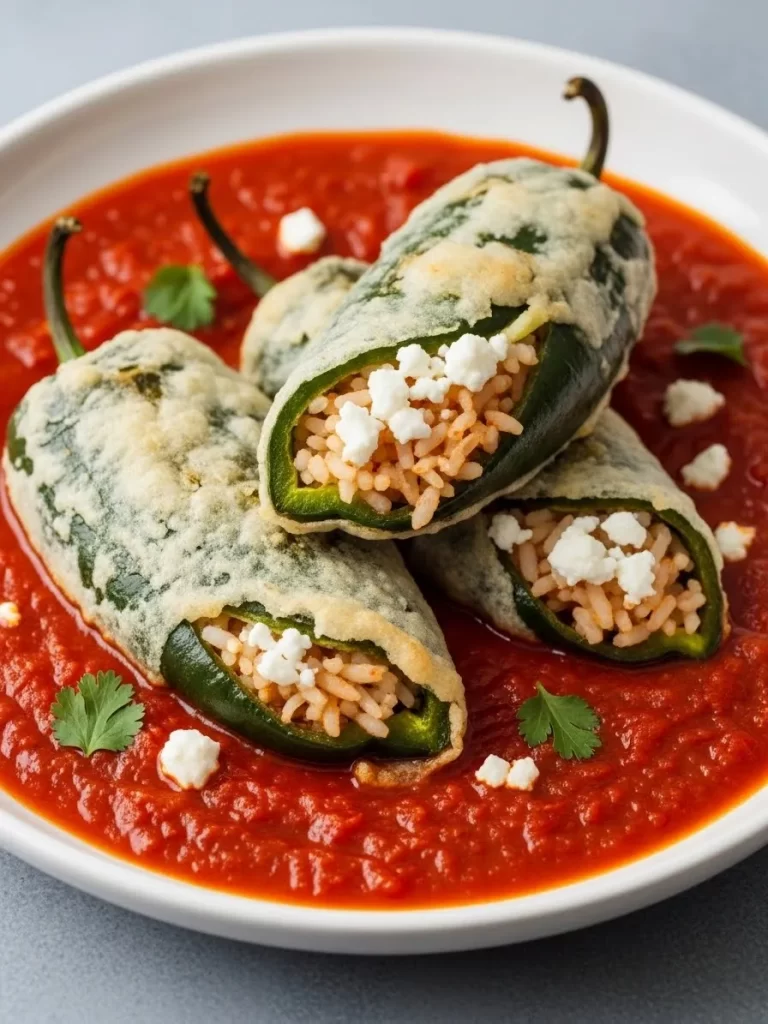
These deep-fried, battered chili peppers make a wonderfully flavorful and substantial centerpiece, served nestled in a rich tomato sauce. The dish is visually striking with its bright red sauce and deep green peppers.
Each large poblano chili is stuffed with a savory filling, likely a mix of rice, and a mild white cheese. The pepper is coated in a delicate, golden-brown egg batter that puffs up slightly during frying, providing a soft exterior texture.
The peppers are generously bathed in a vibrant red ranchera or mild tomato sauce, which complements the subtle heat of the poblanos perfectly. Crumbles of fresh, white queso fresco and tiny cilantro leaves garnish the dish, adding a lovely fresh contrast. This dish is full of comforting, traditional Mexican flavors.
Required Ingredients
For the Chiles:
- 4 large poblano chiles
- 1 cup cooked rice (flavored with tomato or Mexican spices)
- 4 oz Oaxaca, mozzarella, or white cheese, diced
- 4 large eggs, separated
- 1/2 teaspoon salt
- 1/4 cup all-purpose flour
- Vegetable oil, for frying
For the Sauce:
- 1 tablespoon olive oil
- 1 small onion, chopped
- 2 cloves garlic, minced
- 1 (28 oz) can crushed tomatoes
- 1/2 teaspoon cumin
- Salt and black pepper to taste
- Cilantro and queso fresco, for garnish
Equipment List
- Baking sheet
- Large skillet or frying pan
- Two large bowls (one for egg whites, one for yolks)
- Whisk or electric mixer
- Slotted spoon or tongs
DIY Instruction
Step 1: Prepare the Chiles
- Roast the poblano chiles: Place them on a baking sheet and broil or roast them until the skin is blistered and blackened all over (about 5-7 minutes per side).
- Transfer the hot chiles to a bowl and cover tightly with plastic wrap or a kitchen towel for 15 minutes. This steaming helps the skin peel off easily.
- Carefully peel the skin from the chiles. Make a slit down one side of each chile and gently remove the seeds and veins, taking care to keep the chile intact.
- Stuff the chiles: Gently fill each chile with a mixture of the cooked rice and diced cheese. Sprinkle the outside with a light dusting of flour.
Step 2: Prepare the Sauce
- Heat the olive oil in a skillet. Add the onion and cook until soft, about 5 minutes.
- Add the minced garlic, crushed tomatoes, and cumin. Season with salt and pepper.
- Simmer the sauce gently for 15 to 20 minutes to thicken and allow the flavors to combine. Keep the sauce warm.
Step 3: Make the Batter and Fry
- In one large bowl, beat the egg whites with a clean whisk or mixer until stiff peaks form.
- In the second bowl, beat the egg yolks with salt until pale. Gently fold the yolks into the whites to create a fluffy batter.
- Heat 1-2 inches of vegetable oil in a large frying pan until it is shimmering.
- Carefully hold a stuffed chile by the stem and coat it completely in the egg batter.
- Fry the battered chile for 3 to 4 minutes per side until it is golden brown and the cheese inside is melted. Use a slotted spoon to transfer the fried chile to a paper-towel-lined plate to drain.
- Serve the chiles immediately, nestled in a generous amount of the warm ranchera sauce, and topped with queso fresco crumbles and cilantro.
23. Tandoori Paneer and Vegetable Skewers
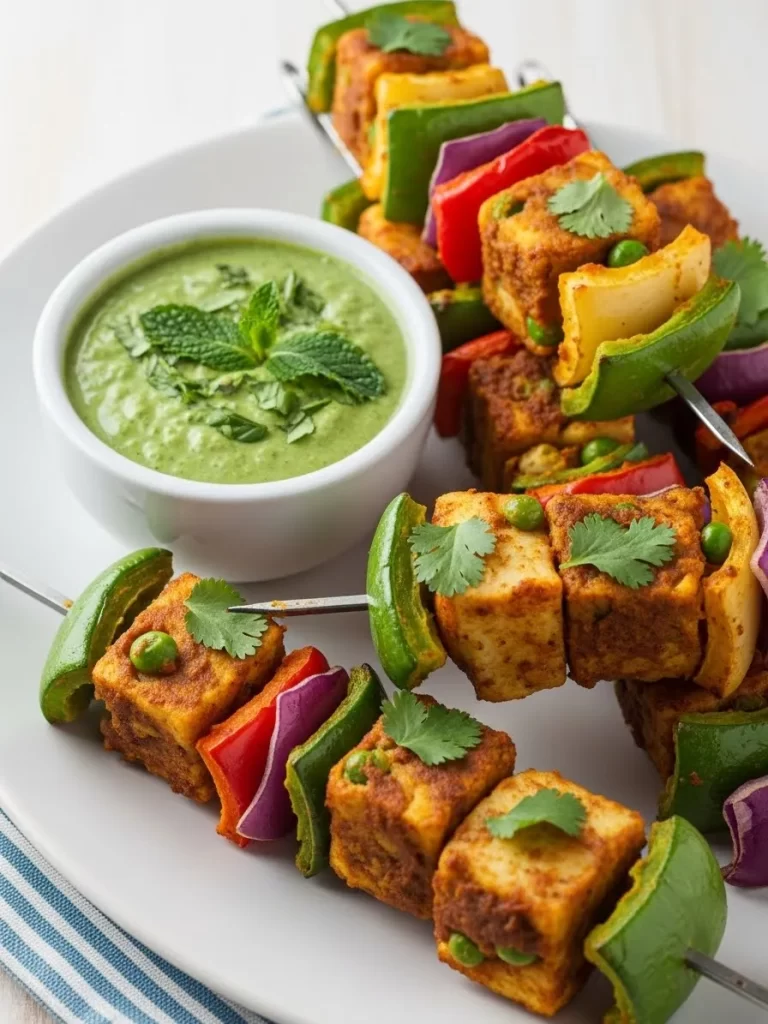
These brightly colored skewers offer a delightful, grilled presentation perfect for a non-traditional holiday main. The presentation is simple and elegant, served on a white platter with a fresh dipping sauce.
The skewers feature large, golden-brown cubes of seasoned paneer (Indian cheese) alternating with vibrant chunks of bell peppers and red onion. The paneer is coated in a rich, dark Tandoori or Tikka marinade, which caramelizes beautifully during grilling.
The skewers are accompanied by a small bowl of creamy green dipping sauce, likely a mint and cilantro chutney, offering a cooling, fresh counterpoint to the smoky, spicy paneer. This dish is hearty, flavor-packed, and visually impressive.
Required Ingredients
For the Skewers:
- 1 block (14-16 oz) paneer, cut into 1-inch cubes
- 1 large green bell pepper, cut into 1-inch pieces
- 1 large red bell pepper, cut into 1-inch pieces
- 1 red onion, cut into 1-inch pieces
- 1/2 cup yogurt (dairy or non-dairy, strained for thickness)
- 2 tablespoons Tandoori or Tikka paste (store-bought or homemade)
- 1 tablespoon lemon juice
- 1 teaspoon grated fresh ginger
- Salt to taste
- Metal or soaked wooden skewers
For the Mint-Cilantro Chutney:
- 1 cup fresh mint leaves
- 1 cup fresh cilantro leaves
- 1 jalapeño, roughly chopped (remove seeds for less heat)
- 1/4 cup lemon juice
- 1/4 cup water
- 1/4 teaspoon salt
Equipment List
- Mixing bowl
- Metal or wooden skewers (if wooden, soak for 30 minutes)
- Grill, grill pan, or oven
- Blender or food processor (for chutney)
DIY Instruction
Step 1: Marinate the Paneer
- In a mixing bowl, combine the yogurt, Tandoori/Tikka paste, lemon juice, grated ginger, and salt. Mix thoroughly to form the marinade.
- Add the paneer cubes, pepper pieces, and onion pieces to the bowl. Gently toss until all the ingredients are fully coated in the thick marinade.
- Cover the bowl and let the paneer and vegetables marinate for at least 30 minutes, or up to 4 hours in the refrigerator.
Step 2: Assemble the Skewers
- Thread the marinated paneer and vegetables alternately onto the skewers. Aim for a mix of colors and textures on each one.
Step 3: Grill or Bake
- Grill Method: Preheat your grill or grill pan to medium-high heat. Lightly oil the grates or pan. Cook the skewers for 3 to 4 minutes per side, turning frequently, until the paneer is lightly charred and the vegetables are tender-crisp.
- Bake Method: Preheat your oven to 400°F (200°C). Place the skewers on a foil-lined baking sheet. Bake for 15 to 20 minutes, turning halfway, until cooked and lightly browned.
Step 4: Prepare the Chutney
- While the skewers cook, make the chutney. Place the mint, cilantro, jalapeño, lemon juice, water, and salt into a blender or food processor.
- Blend until the chutney is completely smooth and bright green. Add a little more water if necessary to achieve a pourable consistency.
- Serve the skewers hot with the fresh Mint-Cilantro Chutney on the side for dipping.
24. Gochujang Glazed Seitan Holiday Roast
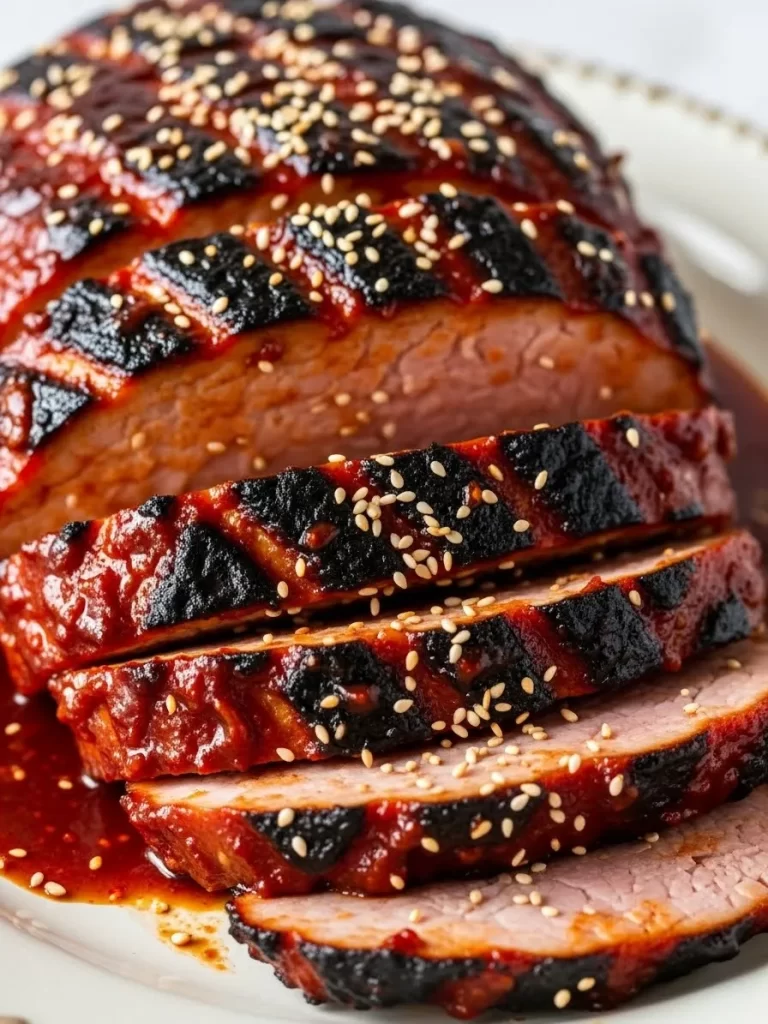
This incredible centerpiece offers a truly modern, savory alternative to traditional roasts, featuring a beautiful deep red glaze and a carvable texture. The seitan loaf is sliced thick, revealing a smooth, meaty interior that holds its shape well.
The exterior boasts a rich, sticky, deep reddish-brown glaze, indicating a powerful sweet, spicy, and umami flavor profile. The cross-section shows the glaze has caramelized slightly, giving it a shiny, slightly charred appearance.
A generous sprinkling of white sesame seeds adheres to the glaze, adding a beautiful visual contrast and a delicate crunch. This roast is an absolute showstopper, proving that plant-based mains can be both elegant and intensely flavorful.
Required Ingredients
For the Roast:
- 1 package (16-18 oz) vital wheat gluten
- 1/2 cup nutritional yeast
- 1 cup vegetable broth
- 1/2 cup soy sauce or tamari
- 1 tablespoon garlic powder
- 1 teaspoon smoked paprika
- 1 teaspoon dried thyme
For the Glaze:
- 1/4 cup Gochujang (Korean chili paste)
- 2 tablespoons maple syrup or brown sugar
- 1 tablespoon sesame oil
- 1 tablespoon rice vinegar
- 1 clove garlic, minced
- White sesame seeds, for garnish
Equipment List
- Mixing bowl
- Whisk
- Aluminum foil
- Steamer pot or Dutch oven with rack
- 9 x 5 inch loaf pan
DIY Instruction
Step 1: Prepare and Steam the Seitan
- In a large bowl, whisk together the vital wheat gluten, nutritional yeast, garlic powder, smoked paprika, and thyme.
- In a separate bowl, whisk together the vegetable broth and soy sauce/tamari.
- Pour the wet ingredients into the dry ingredients. Mix everything until a tough dough forms. Knead the dough gently for about 3 minutes.
- Form the dough into a tight log shape that fits inside your loaf pan. Wrap the log tightly in a double layer of aluminum foil.
- Set up your steamer. Place the wrapped seitan log on a rack inside a steamer pot or Dutch oven over a few inches of simmering water. Steam for 60 to 75 minutes.
- Remove the seitan from the steamer. Unwrap it and let it cool completely.
Step 2: Glaze and Bake the Roast
- Preheat your oven to 400°F (200°C).
- In a small bowl, whisk together all the glaze ingredients (Gochujang, maple syrup, sesame oil, rice vinegar, and garlic).
- Score the cooled seitan log across the top at 1-inch intervals to create deep cuts for the glaze.
- Brush the seitan generously on all sides with half of the glaze mixture.
- Bake for 15 minutes. Remove from the oven, brush with the remaining glaze, and sprinkle liberally with sesame seeds.
- Return to the oven for another 10 to 15 minutes, or until the glaze is bubbling, caramelized, and slightly charred.
- Let the roast rest for 10 minutes before slicing and serving with the residual glaze from the pan.
25. Creamy Tofu and Mushroom Curry

This comforting and vibrant curry offers a complete, flavor-rich main dish, served in a classic side-by-side presentation with rice and potatoes. The generous portion of curry is a rich, satisfying golden yellow.
Cubes of light, firm tofu are mixed into the thick sauce, contrasting beautifully with dark, earthy slices of cremini mushrooms. Diced red bell peppers and other savory vegetables add color and texture to the blend.
Alongside the curry sits a neat mound of fluffy white rice and several plump, halved yellow potatoes. The accompaniment shows this dish is intended as a hearty, complete meal. A sprinkle of fresh parsley over the tofu provides a final touch of fresh color.
Required Ingredients
- 1 tablespoon olive or coconut oil
- 1 block (14-16 oz) extra-firm tofu, pressed and cubed
- 1 medium yellow onion, chopped
- 2 cloves garlic, minced
- 1 cup cremini or button mushrooms, sliced
- 1 small red bell pepper, diced
- 1 (14 oz) can full-fat coconut milk
- 2 tablespoons curry powder (or paste)
- 1 teaspoon grated fresh ginger
- 1/2 teaspoon turmeric (for color)
- 1/2 cup vegetable broth
- Salt and black pepper to taste
- Cooked rice and steamed potatoes, for serving
Equipment List
- Large skillet or pot
- Cutting board and knife
- Measuring cups and spoons
DIY Instruction
Step 1: Cook the Tofu and Aromatics
- Press the tofu for at least 30 minutes. Cut into 1-inch cubes.
- Heat the oil in the large skillet over medium-high heat. Add the tofu and cook for 5 to 7 minutes until golden brown on all sides. Remove the tofu and set it aside.
- In the same skillet, add the chopped onion and cook for 5 minutes until soft.
- Stir in the minced garlic and grated ginger. Cook for 1 minute until fragrant.
Step 2: Build the Curry
- Add the sliced mushrooms and diced bell pepper to the skillet. Cook for 5 minutes until the vegetables soften.
- Sprinkle the curry powder and turmeric over the vegetables. Stir and cook for 2 minutes until the spices are toasted and fragrant.
- Pour in the coconut milk and vegetable broth. Stir everything well, ensuring no spices cling to the bottom of the pan.
- Bring the curry to a gentle simmer. Add the cooked tofu back into the sauce.
Step 3: Simmer and Serve
- Reduce the heat to low and let the curry simmer gently, uncovered, for 10 to 15 minutes, allowing it to thicken slightly and the tofu to absorb the flavors.
- Season the curry with salt and pepper to taste.
- Serve the creamy tofu and mushroom curry immediately, accompanied by fluffy rice and steamed yellow potatoes.
26. Mushroom and Ricotta Phyllo Money Bags
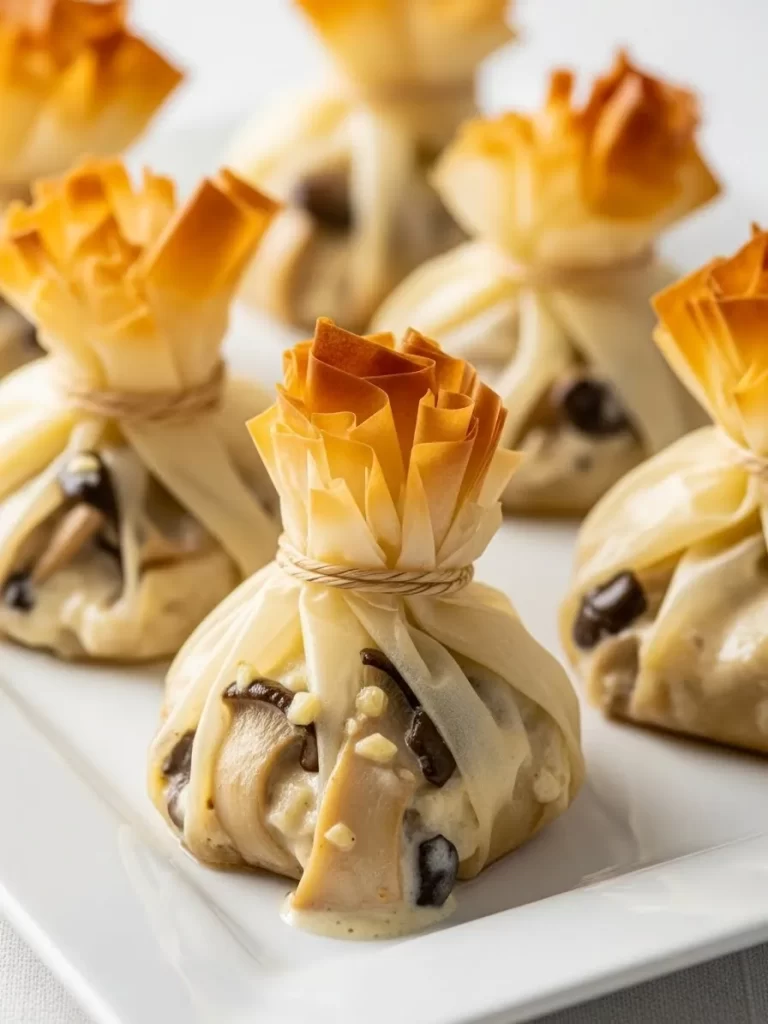
These adorable individual portions make an elegant and visually creative holiday main, showcasing a creamy, savory filling encased in delicate pastry. The money bags are tied neatly at the top, forming a beautiful, slightly browned blossom.
The phyllo pastry is baked to a flaky, golden-brown crispness, creating a wonderful contrast with the soft filling. The top layers of phyllo resemble flower petals, catching the light attractively.
The filling, visible peeking through the pastry, is a rich mixture of chopped mushrooms and creamy ricotta cheese (or a savory vegan alternative). This dish is luxurious, satisfying, and easy for guests to enjoy individually.
Required Ingredients
- 12 sheets phyllo dough (thawed)
- 1/2 cup butter, melted, or olive oil
- 1 tablespoon olive oil
- 8 oz cremini or shiitake mushrooms, chopped
- 1 shallot, finely minced
- 1 clove garlic, minced
- 1/2 cup ricotta cheese (dairy or vegan alternative)
- 1/4 cup chopped fresh parsley
- Salt and black pepper to taste
- Kitchen twine or blanched chives, for tying
Equipment List
- Baking sheet
- Parchment paper
- Small bowl (for melted butter/oil)
- Pastry brush
- Large skillet
- Cutting board and knife
DIY Instruction
Step 1: Prepare the Savory Filling
- Heat the tablespoon of olive oil in the large skillet over medium heat. Add the chopped mushrooms and shallot.
- Cook for 8 to 10 minutes, stirring occasionally, until the mushrooms have released their liquid and are browned.
- Stir in the minced garlic and cook for 1 minute until fragrant. Remove from heat and let the mixture cool completely.
- In a bowl, combine the cooled mushroom mixture with the ricotta cheese, chopped fresh parsley, salt, and pepper. Mix well.
Step 2: Assemble the Money Bags
- Preheat your oven to 375°F (190°C). Line a baking sheet with parchment paper.
- Lay one sheet of phyllo dough on your work surface. Brush it lightly with melted butter or oil. Top with a second sheet of phyllo and brush again.
- Cut the layered phyllo sheet into four equal squares.
- Place a generous spoonful (about 2 tablespoons) of the mushroom filling in the center of each phyllo square.
- Gather the edges of the phyllo upward and around the filling, creating a little pouch. Pinch the pastry closed near the top of the filling and tie it securely with a piece of kitchen twine or a blanched chive. Repeat this process until all the filling is used.
Step 3: Bake and Serve
- Place the assembled phyllo money bags on the prepared baking sheet.
- Bake for 15 to 20 minutes, or until the phyllo is crisp and beautifully golden brown.
- Snip the twine or chive ties before serving. Serve warm as individual savory parcels.
27. Hasselback Butternut Squash with Pecan Glaze
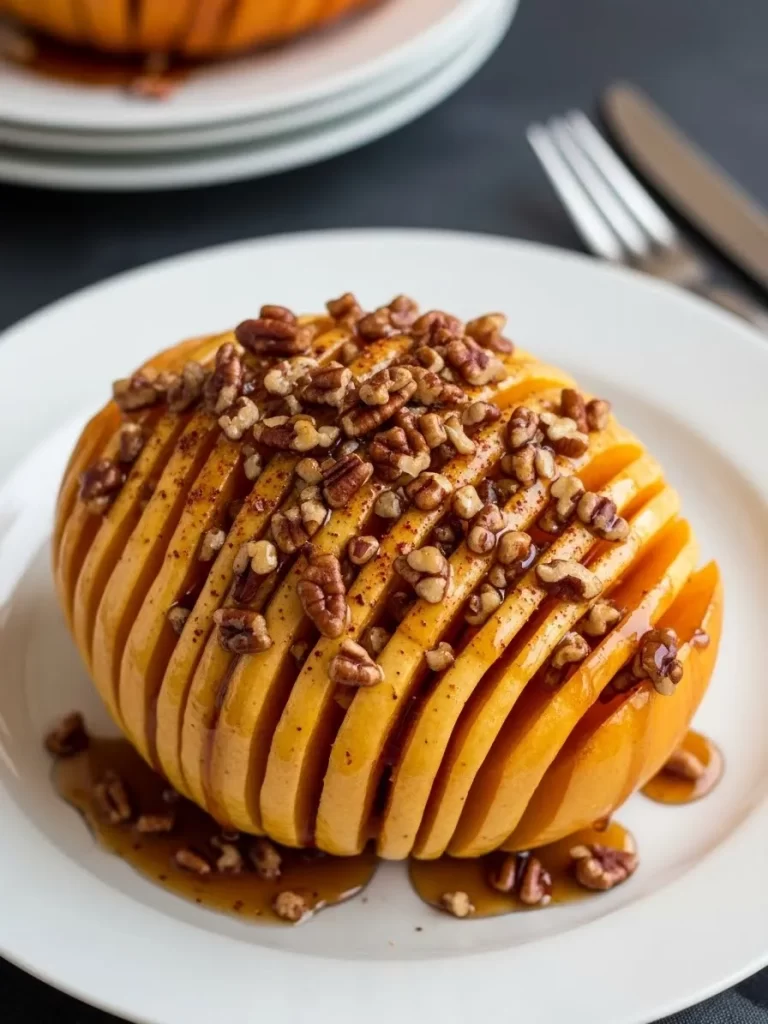
This striking presentation transforms a simple roasted squash into an eye-catching, savory-sweet centerpiece. A single large portion of butternut squash is baked until tender and heavily scored with thin, even slices.
The deep orange flesh of the squash is perfectly exposed by the cuts, allowing a rich, glistening glaze to seep into every layer. The surface is generously coated with a dark, sticky syrup, likely made from maple or brown sugar, providing a beautiful shine.
Scattered liberally over the top are chopped, toasted pecans or walnuts, adding a fantastic holiday texture and flavor. The nuts are nestled into the deep grooves, providing a delightful crunch that balances the smooth, tender squash.
Required Ingredients
- 1 medium butternut squash (about 2-3 lbs), peeled and ends removed
- 2 tablespoons olive oil
- 1/2 teaspoon salt
- 1/4 teaspoon black pepper
- 1/4 cup maple syrup or agave nectar
- 2 tablespoons vegetable broth or water
- 1/2 teaspoon ground cinnamon
- 1/2 cup pecans or walnuts, roughly chopped and lightly toasted
Equipment List
- Baking sheet
- Parchment paper
- Cutting board and sharp knife
- Small saucepan
- Pastry brush
- Wooden spoons or chopsticks (optional, for slicing)
DIY Instruction
Step 1: Prepare and Slice the Squash
- Preheat your oven to 400°F (200°C). Line a baking sheet with parchment paper.
- Halve the peeled butternut squash lengthwise and scoop out the seeds and membranes.
- Place one squash half, cut-side down, on your cutting board. To make the Hasselback slices, place a wooden spoon or chopstick on each side of the squash half. These act as guides, preventing you from slicing all the way through the bottom.
- Slice the squash crosswise into thin cuts (about 1/8 to 1/4 inch thick), stopping when your knife hits the guides.
- Rub the squash with olive oil and sprinkle with salt and pepper. Place cut-side up on the baking sheet.
Step 2: Roast the Squash
- Roast the squash for 30 minutes.
Step 3: Glaze and Finish
- While the squash roasts, make the glaze. In the small saucepan, combine the maple syrup, vegetable broth, and cinnamon. Bring it to a simmer and cook for 1 minute until well combined. Remove from heat.
- After the initial 30 minutes of roasting, remove the squash from the oven. Brush the glaze generously over the top and into the slices.
- Sprinkle the chopped pecans/walnuts over the top, making sure some fall into the grooves.
- Return the squash to the oven and bake for another 15 to 25 minutes, or until the squash is completely tender when pierced with a fork and the glaze is caramelized.
- Serve immediately, spooning any remaining glaze from the pan over the top.
28. Quinoa Stuffed Bell Peppers with Melted Cheese
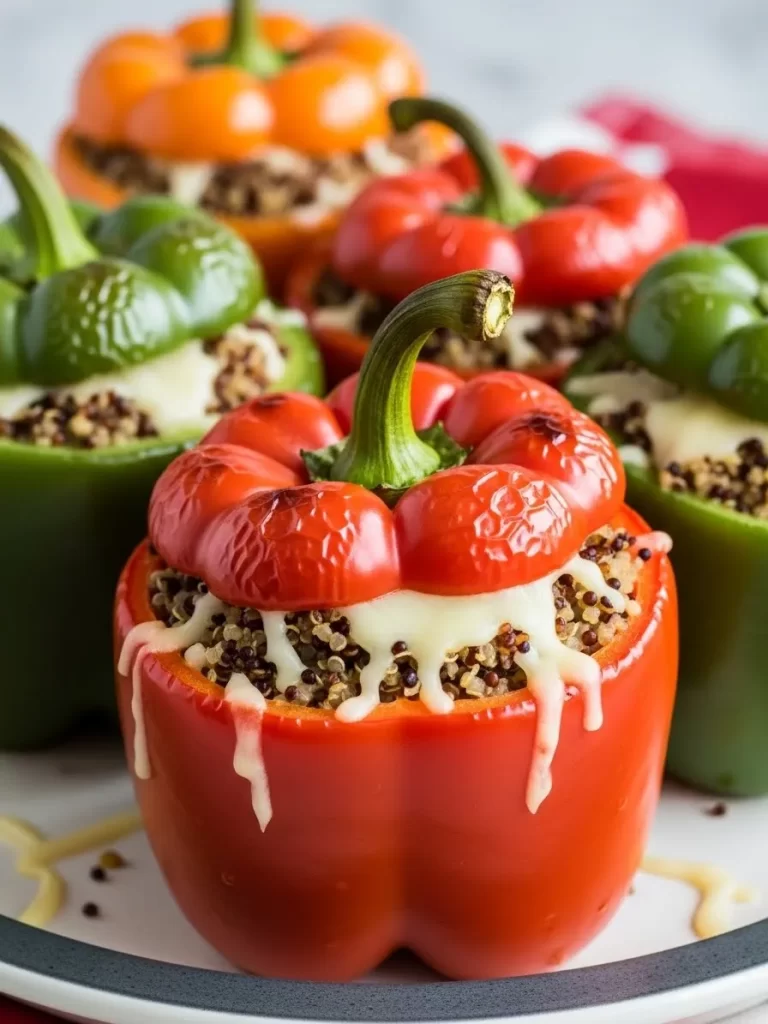
These brightly colored stuffed peppers are a wonderful, photogenic main dish, presented upright to showcase their hearty filling and rich toppings. The collection of peppers features vibrant reds, greens, and oranges, making a festive holiday display.
Each bell pepper is filled to the brim with a savory, dark mixture of cooked quinoa, black beans, corn, and spices. The filling is substantial and packed tightly into the pepper’s cavity.
Melted cheese, possibly Monterey Jack or mozzarella, is draped over the top of the filling, oozing down the pepper’s sides and adding a rich, creamy finish. The pepper’s top portion, acting as a lid, sits charmingly ajar, completing the presentation of this satisfying, grain-based dish.
Required Ingredients
- 4 large bell peppers (red, green, or orange)
- 1 tablespoon olive oil
- 1 small onion, chopped
- 1 clove garlic, minced
- 1 cup cooked quinoa
- 1 (15 oz) can black beans, rinsed and drained
- 1/2 cup corn (frozen or canned)
- 1 teaspoon chili powder
- 1/2 teaspoon cumin
- 1 cup vegetable broth or tomato sauce
- 1 cup shredded cheese (Monterey Jack or vegan alternative)
- Salt and black pepper to taste
Equipment List
- 9 x 13 inch baking dish
- Large skillet
- Cutting board and knife
- Measuring cups and spoons
DIY Instruction
Step 1: Prepare Peppers and Filling
- Preheat your oven to 375°F (190°C).
- Carefully slice the tops off the bell peppers. Remove the seeds and membranes from the inside. Place the pepper shells upright in the baking dish.
- Heat the olive oil in the large skillet over medium heat. Sauté the chopped onion for 5 minutes until soft.
- Stir in the minced garlic, chili powder, and cumin. Cook for 1 minute until fragrant.
- Remove the skillet from heat. Stir in the cooked quinoa, black beans, and corn. Season the mixture with salt and pepper.
Step 2: Stuff and Bake
- Spoon the quinoa mixture generously into each pepper shell, pressing the filling down gently.
- Pour the vegetable broth or tomato sauce into the bottom of the baking dish (about 1/2 inch deep). This helps steam the peppers and keeps them moist.
- Bake for 30 minutes.
Step 3: Add Cheese and Finish
- Remove the dish from the oven. Sprinkle the shredded cheese evenly over the top of the filling in each pepper.
- Return the peppers to the oven and bake for an additional 5 to 10 minutes, or until the cheese is melted and bubbling and the peppers are tender-crisp.
- Allow to cool slightly before serving.
29. Assorted Vegetarian Stuffed Cabbage Rolls
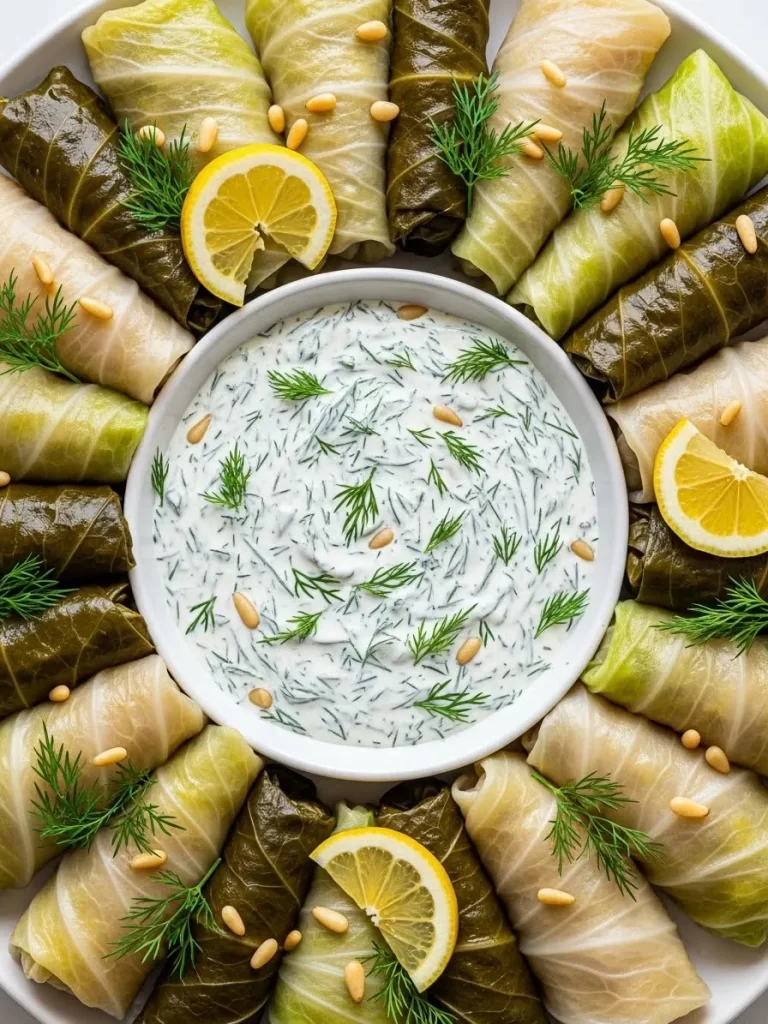
This beautiful, vibrant platter presents a traditional, comforting dish elevated to a holiday display. Cabbage leaves and dark vine leaves are used to create neat, cylindrical rolls, arranged in an attractive wreath shape around a central dipping sauce.
The rolls are carefully wrapped, showing off the light green of the steamed cabbage and the rich, dark green of the vine leaves. This variety of wrapping provides textural and flavor contrasts, hinting at two different but complementary fillings.
In the center is a bowl of creamy, white sauce, likely a garlic and dill yogurt or sour cream, garnished with fresh dill sprigs and pine nuts. Lemon slices are placed around the edge, suggesting a necessary burst of acidity that cuts through the richness of the filling and sauce.
Required Ingredients
For the Rolls:
- 1 large head of green cabbage
- 1 jar grape leaves (optional, rinsed)
- 1 tablespoon olive oil
- 1 medium onion, finely chopped
- 1 cup arborio rice, short-grain rice, or lentils
- 2 cups vegetable broth
- 1/4 cup chopped fresh dill
- 1/4 cup chopped fresh mint
- 1 tablespoon lemon juice
- Salt and black pepper to taste
For the Dipping Sauce (Tzatziki style):
- 1 cup plain yogurt (dairy or non-dairy)
- 1 tablespoon fresh dill, chopped
- 1 clove garlic, minced
- Salt and pepper
- Pine nuts, lightly toasted, for garnish
Equipment List
- Large pot
- Large skillet
- Deep Dutch oven or heavy-bottomed pot (for simmering rolls)
- Mixing bowl
DIY Instruction
Step 1: Prepare the Cabbage Leaves
- Core the head of cabbage. Place the entire head in a large pot of boiling water. Cook for 5 to 8 minutes, gently peeling off the outer leaves as they soften. You will need about 12 to 15 usable leaves.
Step 2: Prepare the Filling
- Heat the olive oil in the large skillet over medium heat. Add the chopped onion and cook for 5 minutes until soft.
- Stir in the rice (or lentils) and cook for 2 minutes until translucent.
- Pour in the vegetable broth and bring the mixture to a simmer. Cover and cook until the rice/lentils have absorbed almost all the liquid and are halfway cooked (about 15 minutes).
- Remove from heat. Stir in the fresh dill, mint, lemon juice, salt, and pepper.
Step 3: Roll the Cabbage/Grape Leaves
- Lay a cabbage leaf (or grape leaf) flat, cut off the thick part of the stem, and place a heaping tablespoon of filling near the base.
- Fold the side edges of the leaf inward over the filling, then roll up tightly from the stem end to form a neat cylinder. Repeat for all leaves.
Step 4: Simmer the Rolls
- Line the bottom of the deep pot or Dutch oven with any unused cabbage leaves (this prevents the rolls from sticking).
- Arrange the rolled cabbage (and grape) rolls tightly in the pot. Pour in enough vegetable broth to cover the rolls halfway.
- Place a plate directly on top of the rolls to keep them submerged. Cover the pot and bring to a simmer.
- Cook on low heat for 45 to 60 minutes, or until the filling is fully cooked and the leaves are very tender.
Step 5: Prepare the Sauce and Serve
- Mix the yogurt, chopped dill, minced garlic, salt, and pepper in a small bowl.
- Arrange the cooked rolls attractively on a platter around the sauce. Garnish the sauce with pine nuts and serve warm with a squeeze of fresh lemon.
30. Mini Apple and Feta Cheese Tarts
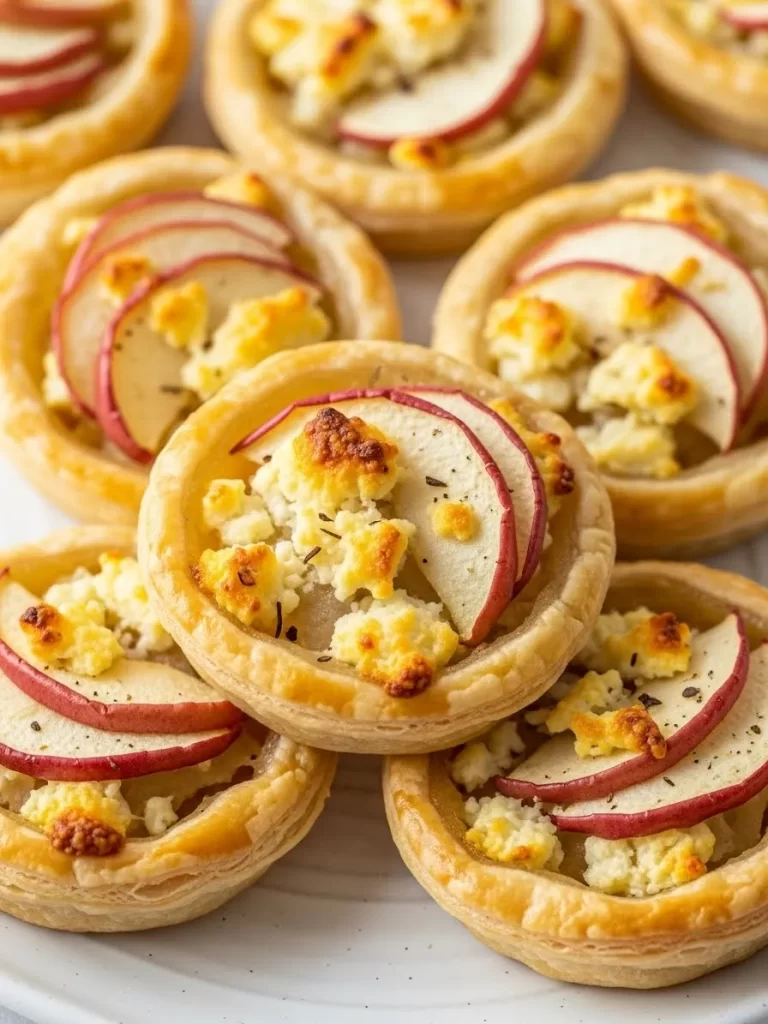
These individual savory-sweet tarts offer a delicate and charming starter or light main course for a festive brunch or dinner. Presented neatly stacked on a platter, their golden crusts and colorful toppings are instantly appealing.
Each tart features a small, round base of flaky puff pastry, baked to a beautiful golden-brown color. The edges are crimped or folded slightly, creating a neat frame for the vibrant filling.
The topping is a harmonious mix of sweet and savory: thin, overlapping slices of bright red apple are arranged in the center. Crumbling feta cheese is scattered over the apples, adding a salty tang and lending a slightly browned, rustic look when baked.
Required Ingredients
- 1 sheet ready-rolled puff pastry (thawed)
- 1 medium red apple (such as Honeycrisp or Gala), thinly sliced
- 4 oz feta cheese, crumbled
- 1 tablespoon olive oil or melted butter
- 1/2 teaspoon dried thyme or oregano
- 1 tablespoon brown sugar or maple syrup (optional)
- 1 egg (beaten, for egg wash)
Equipment List
- Baking sheet
- Parchment paper
- 3-inch round cookie cutter
- Small bowl
- Pastry brush
DIY Instruction
Step 1: Prepare the Pastry Rounds
- Preheat your oven to 400°F (200°C). Line a baking sheet with parchment paper.
- Unroll the puff pastry sheet. Use the round cookie cutter to cut out as many rounds as possible (usually 8-10).
- Place the pastry rounds on the prepared baking sheet. Using a smaller cutter or knife, lightly score a smaller circle inside the round, leaving a 1/2 inch border. Do not cut all the way through the pastry.
Step 2: Assemble the Tarts
- Brush the entire surface of each pastry round lightly with olive oil or melted butter.
- Arrange 3 to 4 thin apple slices neatly within the lightly scored circle of each round, overlapping them slightly.
- Sprinkle the apple slices and the exposed pastry edge with the dried thyme or oregano. If using, drizzle a tiny amount of brown sugar or maple syrup over the apples.
- Scatter the crumbled feta cheese evenly over the apples in the center of each tart.
Step 3: Bake
- Lightly brush the outer pastry border (the part you did not score) with the beaten egg wash.
- Bake for 15 to 20 minutes, or until the pastry is puffed up, golden brown, and the apples are tender.
- Allow the tarts to cool slightly on the baking sheet before serving warm.
31. Pan-Seared Celeriac Steaks with Hazelnut Romesco
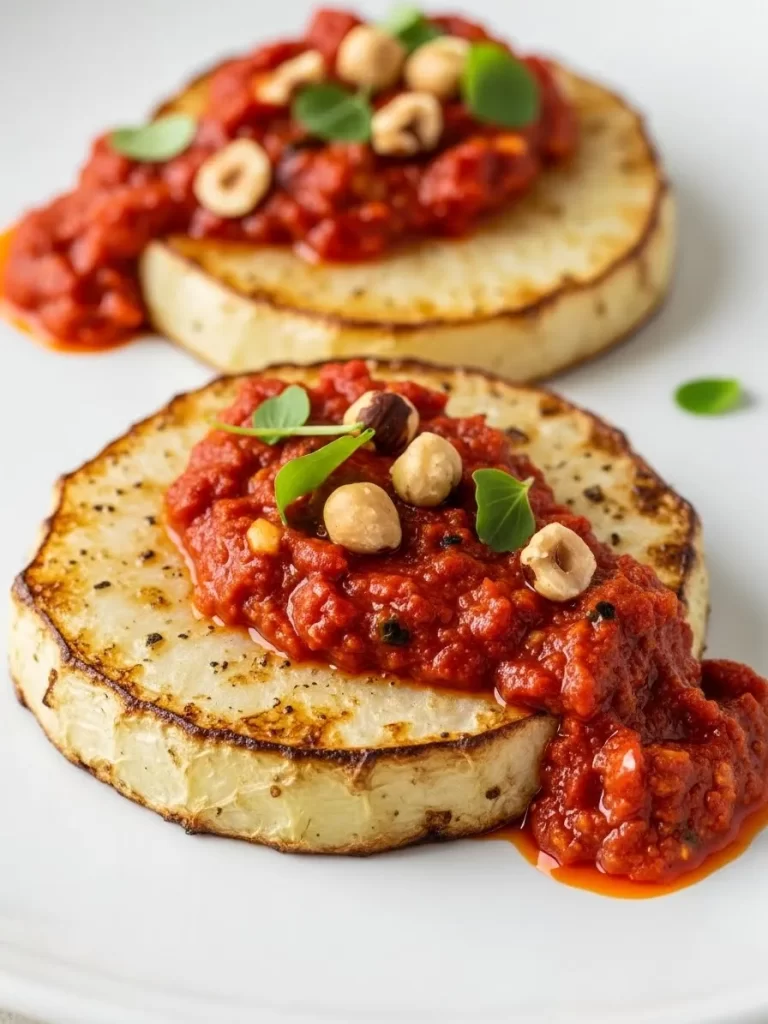
This elegant dish transforms a humble root vegetable into a sophisticated main course, focusing on presentation and rich, concentrated flavor. Two thick, round slices of celeriac (celery root) are pan-seared and presented on a white plate.
The celeriac steaks have a beautiful, light golden-brown crust achieved by searing, giving them a savory, slightly smoky note that contrasts the vegetable’s subtle sweetness. The interior remains pale and tender.
A generous spoonful of vibrant red Romesco sauce, featuring roasted tomatoes and peppers, is draped artistically over the top of each steak. Toasted hazelnuts are scattered over the sauce, providing an earthy crunch and visual appeal, completed by a few fresh oregano leaves.
Required Ingredients
For the Celeriac Steaks:
- 1 large celeriac (celery root), peeled
- 3 tablespoons olive oil
- 1/2 teaspoon salt
- 1/4 teaspoon black pepper
- 1/4 teaspoon smoked paprika
For the Hazelnut Romesco Sauce:
- 1/2 cup jarred roasted red peppers, drained
- 1/4 cup toasted hazelnuts, plus extra for garnish
- 1 clove garlic
- 2 tablespoons red wine vinegar
- 1/4 cup olive oil
- Pinch of smoked paprika
- Salt to taste
- Fresh oregano leaves, for garnish
Equipment List
- Sharp knife and cutting board
- Large, heavy skillet or cast iron pan
- Food processor or blender
- Measuring cups and spoons
DIY Instruction
Step 1: Prepare the Celeriac
- Slice the peeled celeriac into four thick, even rounds (about 3/4 inch thick). You will discard the ends and any irregular pieces.
- Bring a pot of salted water to a boil. Gently place the celeriac slices into the boiling water and blanch them for 5 to 7 minutes until they are slightly tender but still firm. Drain the slices thoroughly and pat them very dry.
- Rub the blanched slices with 1 tablespoon of olive oil, salt, pepper, and smoked paprika.
Step 2: Make the Romesco Sauce
- In a food processor or blender, combine the roasted red peppers, toasted hazelnuts, garlic clove, red wine vinegar, and the pinch of smoked paprika.
- Pulse the mixture until it is roughly combined. While the processor is running, slowly drizzle in the 1/4 cup of olive oil until the sauce emulsifies and reaches a slightly chunky, but mostly smooth, consistency.
- Taste and season the Romesco sauce with salt. Set aside.
Step 3: Sear the Steaks
- Heat the remaining 2 tablespoons of olive oil in the large, heavy skillet over medium-high heat.
- Carefully place the seasoned celeriac slices in the hot pan. Sear for 4 to 6 minutes per side, pressing gently with a spatula, until each side develops a deep golden-brown crust.
Step 4: Assemble and Serve
- Place the seared celeriac steaks onto individual plates.
- Spoon a generous amount of the Romesco sauce over the top of each steak.
- Garnish with the extra toasted hazelnuts and fresh oregano leaves. Serve immediately.
32. Jeweled Saffron Rice Pilaf with Roasted Carrots
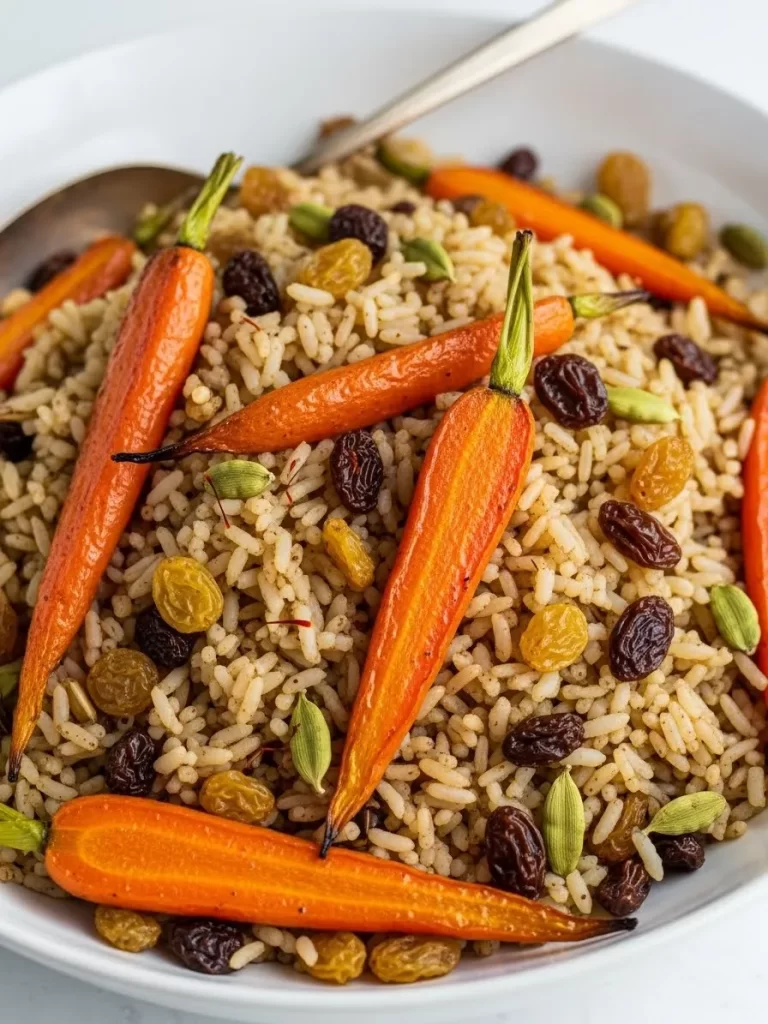
This colorful and aromatic rice dish is an exceptional main course or a spectacular side, showcasing a rich array of spices and textural contrasts. The long-grain rice pilaf is served mounded in a deep white bowl, signaling a hearty, substantial portion.
The rice is seasoned with saffron and cardamom, lending it a beautiful pale yellow color and exotic aroma. Mixed throughout are dark and golden raisins, providing bursts of fruity sweetness, and vibrant green cardamom pods, adding to the visual appeal.
Whole, slender roasted carrots, glazed a rich orange color and still bearing their green tops, are nestled on top of the rice. This dish is an excellent example of a light yet fulfilling, globally-inspired vegetarian main.
Required Ingredients
- 2 tablespoons olive oil or butter
- 1 medium yellow onion, finely chopped
- 1 1/2 cups Basmati rice, rinsed until water runs clear
- 3 cups vegetable broth
- 1/4 teaspoon saffron threads (soaked in 1 tablespoon hot water)
- 4 whole green cardamom pods
- 1/2 teaspoon ground cinnamon
- 1/4 cup dark raisins
- 1/4 cup golden raisins
- 1 pound slender carrots, scrubbed (leave a little green top for visual appeal)
- Salt and black pepper to taste
- Chopped pistachios or almonds, for garnish (optional)
Equipment List
- Medium oven-safe pot with a tight-fitting lid (or Dutch oven)
- Small bowl (for saffron)
- Baking sheet
- Cutting board and knife
DIY Instruction
Step 1: Roast the Carrots
- Preheat your oven to 400°F (200°C).
- Toss the carrots with 1 tablespoon of the olive oil, salt, and pepper. Spread them on a baking sheet.
- Roast for 15 to 20 minutes, or until the carrots are tender and slightly caramelized. Set aside.
Step 2: Prepare the Rice Base
- Heat the remaining 1 tablespoon of oil or butter in the pot over medium heat. Add the chopped onion and cook for 5 minutes until soft.
- Add the rinsed rice to the pot and toast for 2 minutes, stirring constantly.
- Pour in the vegetable broth and the saffron threads with their soaking water. Add the cardamom pods, cinnamon, salt, and pepper. Bring the mixture to a boil.
Step 3: Simmer the Pilaf
- Once boiling, stir in both types of raisins. Reduce the heat to the lowest setting, cover the pot tightly, and simmer for 15 minutes. Do not lift the lid.
- Remove the pot from the heat and let it stand, still covered, for 10 minutes. This steaming process completes the cooking and makes the rice fluffy.
Step 4: Finish and Serve
- Remove the lid and gently fluff the rice with a fork, discarding the cardamom pods.
- Transfer the jeweled pilaf to a serving bowl. Arrange the warm roasted carrots attractively over the top.
- Garnish with chopped nuts, if using, and serve warm.
33. Lentil and Fig “Meatballs” with Balsamic Glaze
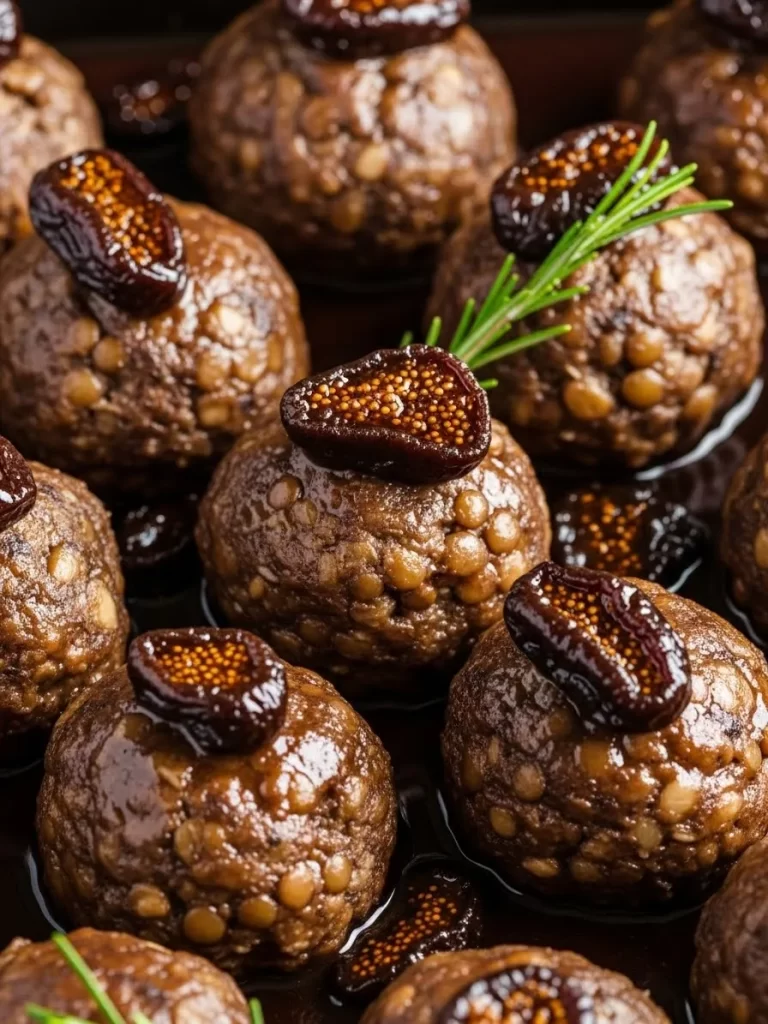
These glossy, dark “meatballs” are an unexpectedly decadent holiday main, offering rich flavor and a substantial texture. Served nestled together in a dark dish, the deep color is visually appealing and signals the intense flavor within.
The lentil balls are formed from a dense mixture of cooked lentils, grains, and seasonings, achieving a firm, rounded shape. They are bathed in a thick, deep brown balsamic or fig glaze that provides a powerful sweet and sour counterpoint.
Capping the top of each ball is a slice of dried fig, which provides a beautiful contrasting color and texture, as well as reinforcing the fruit-driven sweetness. A few sprigs of fresh rosemary are tucked into the arrangement, adding a final, fragrant, herbal touch.
Required Ingredients
For the Lentil Balls:
- 1 tablespoon olive oil
- 1 medium onion, finely chopped
- 2 cloves garlic, minced
- 1 1/2 cups cooked green or brown lentils, mashed lightly
- 1/2 cup breadcrumbs or rolled oats
- 1/4 cup soy sauce or tamari
- 1 teaspoon dried thyme
- 1/2 teaspoon smoked paprika
- Salt and black pepper to taste
For the Fig Glaze:
- 1/2 cup balsamic vinegar
- 1/4 cup fig jam or preserves
- 1/4 cup vegetable broth
- 1 teaspoon Dijon mustard
- Dried figs, halved, for garnish
- Fresh rosemary sprigs, for garnish
Equipment List
- Large skillet
- Mixing bowl
- Baking sheet
- Parchment paper
- Small saucepan
DIY Instruction
Step 1: Prepare the Lentil Mixture
- Preheat your oven to 375°F (190°C). Line a baking sheet with parchment paper.
- Heat the olive oil in the large skillet over medium heat. Add the chopped onion and cook for 5 minutes until soft. Add the minced garlic and cook for 1 minute.
- In a mixing bowl, combine the onion mixture, mashed lentils, breadcrumbs/oats, soy sauce/tamari, thyme, smoked paprika, salt, and pepper. Mix thoroughly until the mixture is cohesive and holds its shape easily.
Step 2: Form and Bake the Balls
- Roll the mixture into small, uniform balls (about 1.5 inches in diameter).
- Place the balls on the prepared baking sheet. Bake for 20 to 25 minutes, until the outsides are firm and lightly browned.
Step 3: Make the Fig Glaze
- While the lentil balls bake, combine the balsamic vinegar, fig jam, vegetable broth, and Dijon mustard in a small saucepan.
- Bring the mixture to a simmer over medium heat. Reduce the heat and cook gently for 5 to 7 minutes until the glaze has thickened to a syrupy consistency.
Step 4: Glaze and Garnish
- Once the lentil balls are baked, gently toss them in the warm fig glaze to coat them completely.
- Transfer the glazed balls to a serving dish. Top each ball with a halved dried fig.
- Garnish the dish with sprigs of fresh rosemary and serve immediately.
34. Layered Savory Crêpe Cake with Squash and Kale
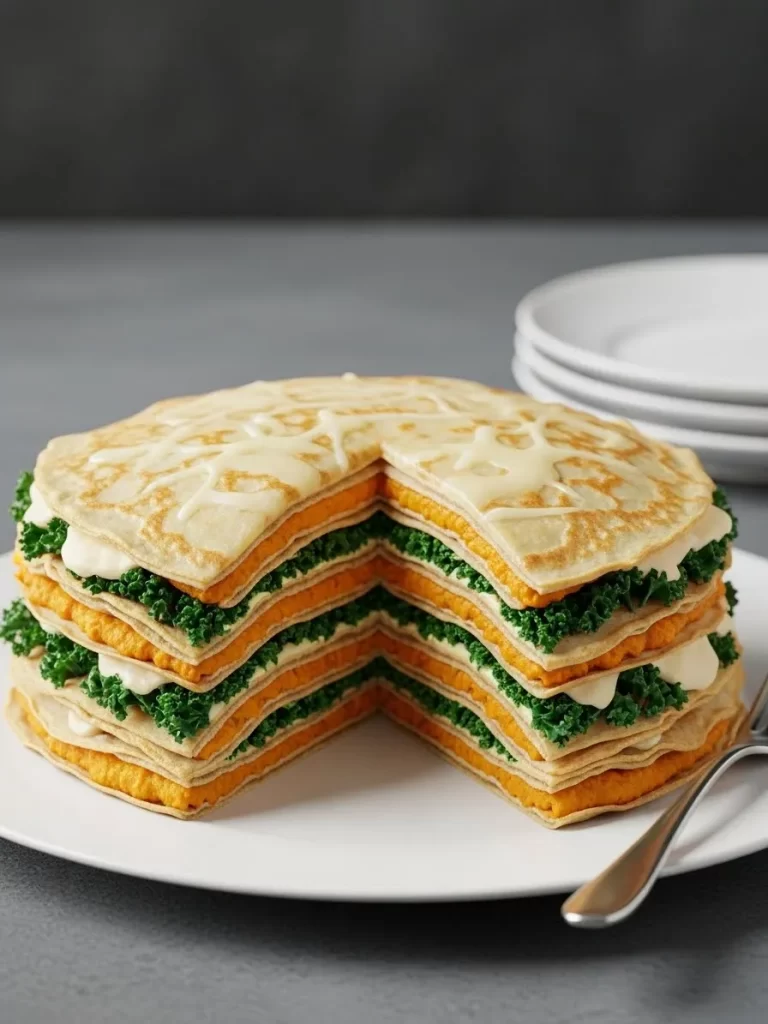
This spectacular savory “cake” is a true showpiece, presenting an architectural structure of alternating, vibrant layers. A thick slice is cut, revealing the striking, stacked interior.
The base is composed of thin, delicate crêpes, providing a soft, flexible layer for the fillings. Alternating with the crêpes are two colorful fillings: a creamy, bright orange layer of seasoned butternut squash or pumpkin puree.
The next layer is a vibrant, dark green, composed of sautéed kale or spinach, providing an earthy contrast. A thin layer of white cream or cheese sauce (likely ricotta or a savory cashew cream) separates each layer, acting as a “frosting.” This impressive dish is both hearty and light, a wonderful surprise for a festive meal.
Required Ingredients
For the Crêpes (makes about 10-12):
- 1 cup all-purpose flour
- 2 large eggs
- 1 cup milk (dairy or non-dairy)
- 1/2 cup water
- 1/4 teaspoon salt
- 1 tablespoon melted butter or oil
For the Fillings:
- 2 cups butternut squash puree, seasoned with sage and salt
- 5 oz kale or spinach, sautéed until tender and squeezed dry
- 1 cup ricotta, goat cheese, or savory cashew cream, seasoned with salt and herbs
Equipment List
- Blender or mixing bowl and whisk (for crêpes)
- 8-inch non-stick skillet (for crêpes)
- Baking sheet or large round platter (for assembly)
- Spatula
DIY Instruction
Step 1: Make and Cook the Crêpes
- In a blender or mixing bowl, combine all the crêpe ingredients (flour, eggs, milk, water, salt, and melted butter). Blend or whisk until the batter is completely smooth.
- Heat the 8-inch non-stick skillet over medium heat. Pour about 1/4 cup of batter into the hot pan, quickly tilting the pan to coat the bottom evenly with a thin layer.
- Cook for about 1 minute per side until lightly golden. Stack the finished crêpes on a plate. You will need about 8-10 crêpes for the cake.
Step 2: Prepare the Fillings
- Ensure the squash puree is smooth and seasoned (sage, salt, pepper).
- Ensure the kale/spinach is sautéed, seasoned (garlic, salt), and very dry.
- Ensure the ricotta/cream is seasoned (salt, pepper, perhaps a little lemon zest) and easily spreadable.
Step 3: Assemble the Crêpe Cake
- Place the first crêpe on your serving plate or baking sheet.
- Spread a thin, even layer of the seasoned squash puree over the crêpe.
- Top with a second crêpe. Spread a thin layer of the ricotta/cheese cream over this crêpe.
- Top with a third crêpe. Spread a layer of the sautéed kale/spinach.
- Repeat this layering pattern (Crêpe, Squash, Crêpe, Ricotta, Crêpe, Kale) until you have used all the desired crêpes and fillings, ending with a crêpe on top.
- Chill the cake for at least 30 minutes (or up to 4 hours) to allow the layers to set. Before serving, drizzle the top crêpe with any remaining cheese cream or sauce.
35. Savory Black Bean and Sweet Potato Loaf with Avocado Topping
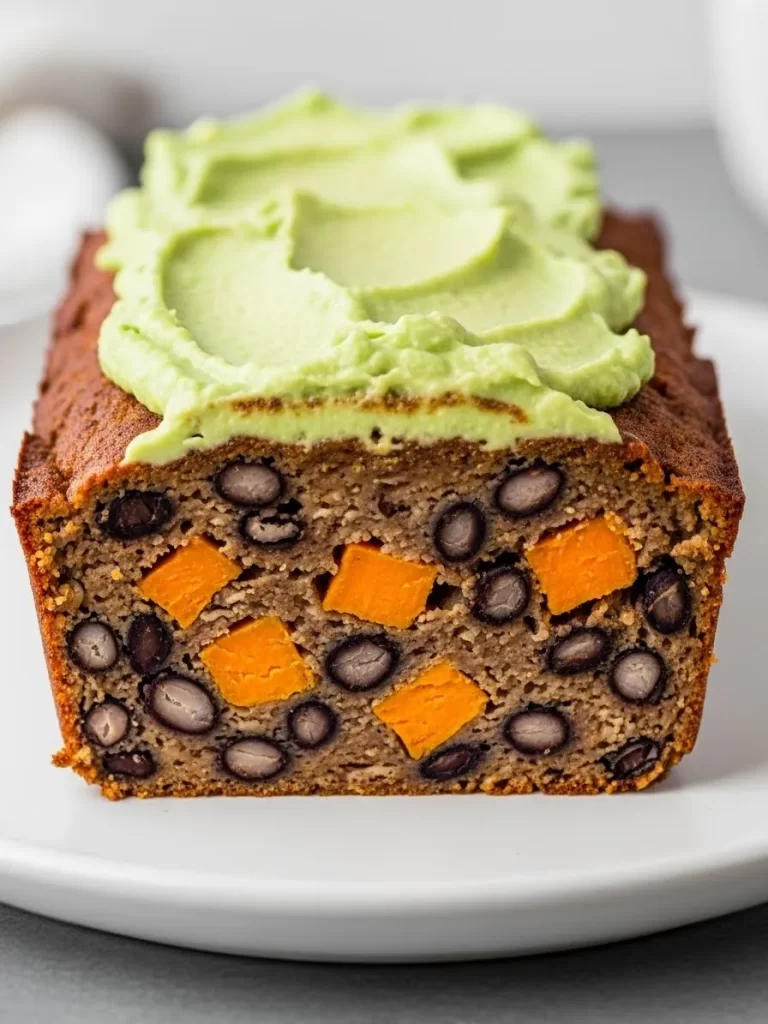
This strikingly graphic loaf offers a wholesome, nutrient-dense main dish, visually defined by its contrasting colors. Sliced down the middle, the loaf reveals a dramatic mosaic of black and orange.
The base of the loaf is a savory mixture of grains, providing a hearty texture. Embedded throughout are whole black beans, creating a dark, earthy color, interspersed with bright, cubed sweet potato pieces. This combination yields a satisfying balance of sweet, savory, and starchy flavors.
Crowning the top of the loaf is a thick, creamy layer of pale green avocado frosting or mousse. This adds a beautiful cool, creamy finish that contrasts the baked warmth of the loaf beautifully, making it a truly unique centerpiece.
Required Ingredients
For the Loaf:
- 1 tablespoon olive oil
- 1 medium yellow onion, finely chopped
- 1 cup sweet potato, peeled and cut into 1/2-inch dice
- 1 (15 oz) can black beans, rinsed and drained
- 1 cup cooked brown rice or quinoa
- 1/2 cup breadcrumbs or rolled oats
- 1/4 cup vegetable broth
- 1 teaspoon ground cumin
- 1/2 teaspoon chili powder
- 1/2 teaspoon salt
For the Avocado Topping:
- 1 ripe avocado
- 1 tablespoon lime juice
- 1 clove garlic (optional)
- Salt to taste
Equipment List
- 9 x 5 inch loaf pan
- Parchment paper
- Large skillet
- Food processor or blender (for topping)
- Mixing bowl
DIY Instruction
Step 1: Prep Vegetables and Bake Sweet Potato
- Preheat your oven to 375°F (190°C).
- Toss the diced sweet potato cubes with a small amount of olive oil and a pinch of salt. Roast for 10 to 15 minutes, or until just tender. Remove and set aside.
- Line the loaf pan with parchment paper.
Step 2: Create the Loaf Base
- Heat the remaining olive oil in the large skillet. Add the chopped onion and cook for 5 minutes until soft.
- In a large mixing bowl, combine the cooked brown rice/quinoa, breadcrumbs/oats, vegetable broth, cumin, chili powder, and salt.
- Gently fold in the sautéed onion, the rinsed black beans, and the roasted sweet potato cubes. Mix carefully so as not to mash the sweet potato.
Step 3: Bake the Loaf
- Transfer the mixture to the prepared loaf pan. Press the mixture down firmly and evenly.
- Bake for 45 to 55 minutes, or until the loaf is firm and the top is dark golden brown.
- Remove from the oven and let it cool in the pan for 10 minutes, then lift it out onto a wire rack to cool completely.
Step 4: Make and Add Topping
- In a food processor or blender, combine the avocado, lime juice, garlic (if using), and salt. Process until the mixture is completely smooth and creamy.
- Spread the avocado topping generously over the cooled loaf before slicing and serving.
36. Saffron Fregola with Baby Mozzarella and Olives
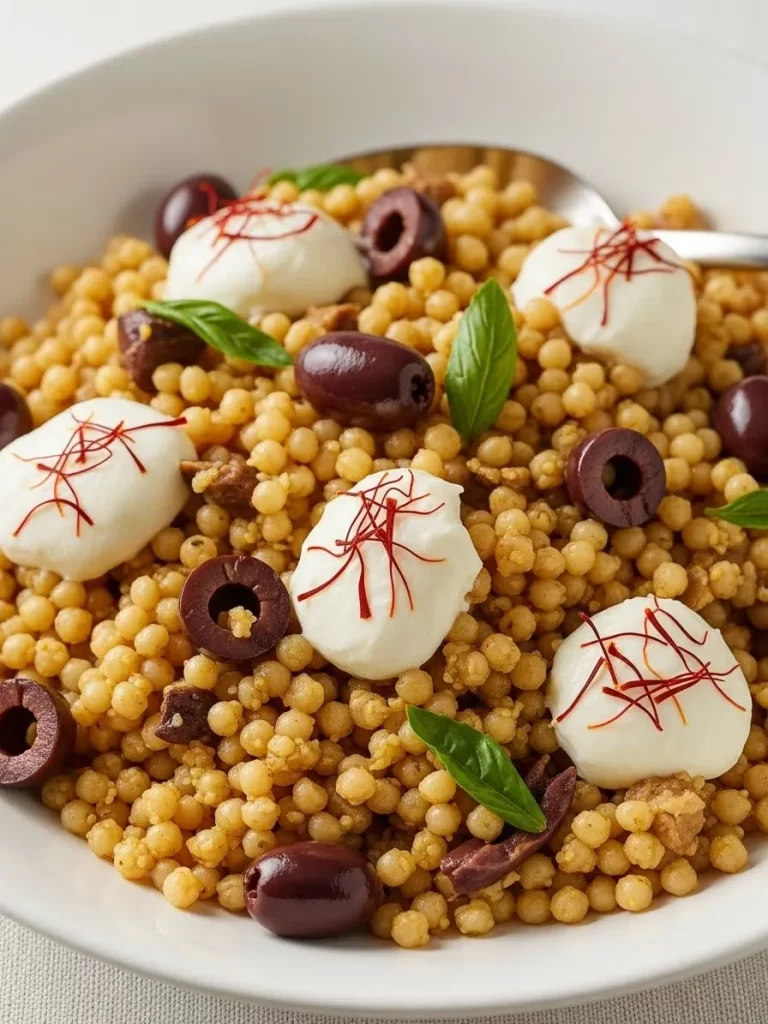
This sophisticated pasta salad or warm grain dish offers Mediterranean flair with a beautiful golden color and a mix of delicate ingredients. The dish is presented mounded in a deep white bowl, showing off the pearl-like pasta.
The small, toasted pasta (fregola or Israeli couscous) is cooked in saffron, giving it a light gold hue and a subtle, floral aroma. Mixed throughout are chunks of flavorful, dark Kalamata or black olives.
Scattered across the top are small, white balls of fresh baby mozzarella (bocconcini), which add a creamy, cool texture. A few delicate saffron threads top the mozzarella, and fresh basil leaves are tucked in, providing a beautiful color contrast and fresh herbal note.
Required Ingredients
- 2 tablespoons olive oil
- 1 cup fregola or Israeli couscous
- 2 cups vegetable broth
- 1/4 teaspoon saffron threads
- 1/4 cup toasted walnuts or pine nuts
- 1/2 cup pitted Kalamata olives, halved
- 6 oz baby mozzarella balls (bocconcini), drained
- 1/4 cup fresh basil leaves
- Salt and black pepper to taste
Equipment List
- Medium saucepan
- Large skillet
- Cutting board and knife
- Serving bowl
DIY Instruction
Step 1: Cook the Fregola
- Heat 1 tablespoon of olive oil in the saucepan over medium heat. Add the fregola and toast, stirring constantly, for 3 to 5 minutes until the pearls are lightly golden and fragrant.
- Pour in the vegetable broth and add the saffron threads and salt. Bring to a boil, then reduce the heat to low, cover, and simmer for 10 to 12 minutes, or until the liquid is absorbed and the pasta is tender. Fluff with a fork and set aside.
Step 2: Prepare Mix-Ins
- Heat the remaining 1 tablespoon of olive oil in the large skillet over medium heat. Add the toasted nuts and halved olives, stirring quickly for 2 minutes to warm them slightly.
- Remove from heat. Gently toss the warm fregola, the nut and olive mixture, and a pinch of black pepper together in the serving bowl.
Step 3: Garnish and Serve
- Gently nestle the drained baby mozzarella balls throughout the warm fregola mixture. The warmth will slightly soften the cheese.
- Garnish the dish with the fresh basil leaves.
- For added visual appeal, place a few saffron threads delicately on top of the mozzarella balls. Serve immediately while warm.
37. Whole Roasted Romanesco with Caper-Tomato Sauce
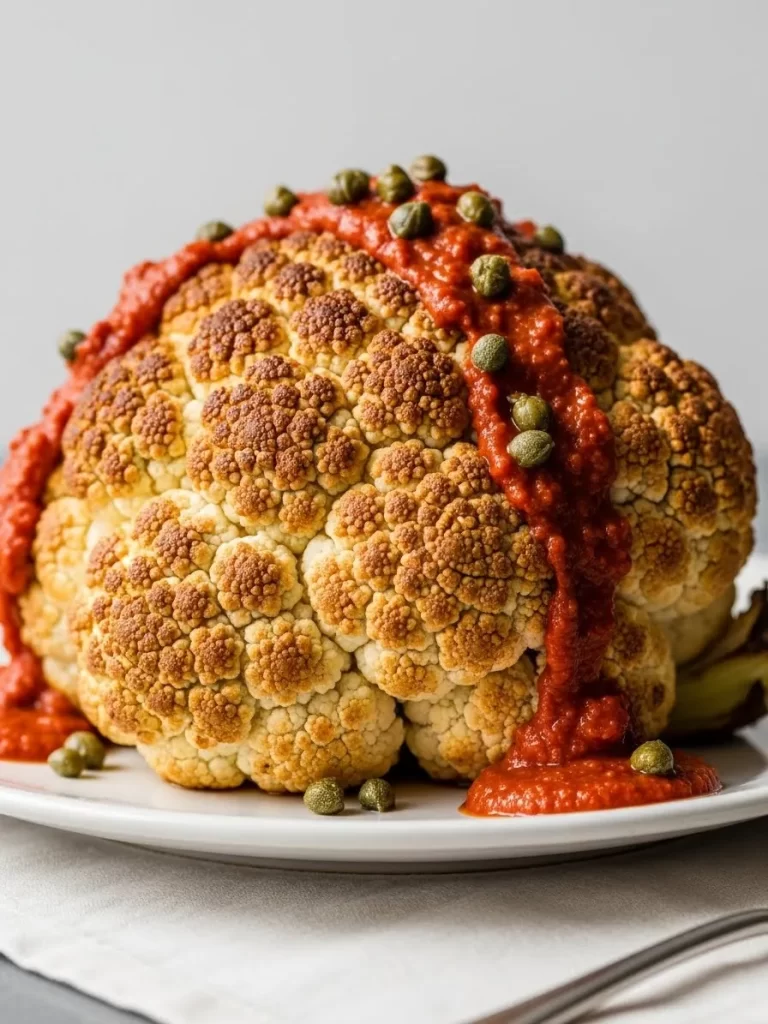
This visually dramatic dish uses a whole roasted Romanesco cauliflower as an impressive, sculptural main course. The Romanesco is placed centrally on a white plate, highlighting its unique fractal texture and golden-brown roast color.
The outer edges of the Romanesco are deeply caramelized, indicating a tender, nutty interior. A rich, vibrant red tomato sauce is poured generously over the top, flowing down the side and into the deep crevices of the vegetable.
Scattered over the sauce are whole, bright green capers, adding a necessary salty, briny flavor that cuts through the richness of the tomato and the sweetness of the roasted vegetable. This is a wonderfully rustic and elegant centerpiece.
Required Ingredients
- 1 medium head of Romanesco cauliflower
- 2 tablespoons olive oil, plus more for the sauce
- 1/2 teaspoon salt
- 1/4 teaspoon black pepper
- 1 medium yellow onion, chopped
- 2 cloves garlic, minced
- 1 (28 oz) can crushed tomatoes
- 2 tablespoons drained capers, plus more for garnish
- 1 teaspoon dried oregano
- 1/2 teaspoon red pepper flakes (optional)
Equipment List
- Baking sheet
- Large pot (optional, for pre-boiling)
- Large skillet
- Cutting board and knife
DIY Instruction
Step 1: Prepare and Roast the Romanesco
- Preheat your oven to 400°F (200°C).
- Carefully trim the base and any tough leaves from the Romanesco, keeping the head intact.
- For quicker cooking, you may pre-boil the Romanesco in a large pot of salted water for 8 minutes, then drain and pat dry.
- Rub the entire head with the 2 tablespoons of olive oil, salt, and pepper.
- Place the Romanesco on the baking sheet and roast for 35 to 45 minutes, or until the edges are golden brown and a knife slides easily into the center.
Step 2: Make the Caper-Tomato Sauce
- While the Romanesco roasts, heat a little olive oil in the large skillet over medium heat. Add the chopped onion and cook until soft, about 5 minutes.
- Stir in the minced garlic, dried oregano, and red pepper flakes (if using). Cook for 1 minute until fragrant.
- Add the crushed tomatoes and 2 tablespoons of drained capers. Simmer gently for 15 minutes to allow the sauce to thicken slightly and the flavors to meld. Season with salt and pepper.
Step 3: Serve
- Carefully transfer the whole roasted Romanesco to a serving platter.
- Spoon the warm caper-tomato sauce generously over the top of the Romanesco, allowing it to drizzle down the sides.
- Garnish with extra whole capers before serving, presenting the dish whole at the table.
38. Baked Brie in Puff Pastry with Warm Pears and Thyme
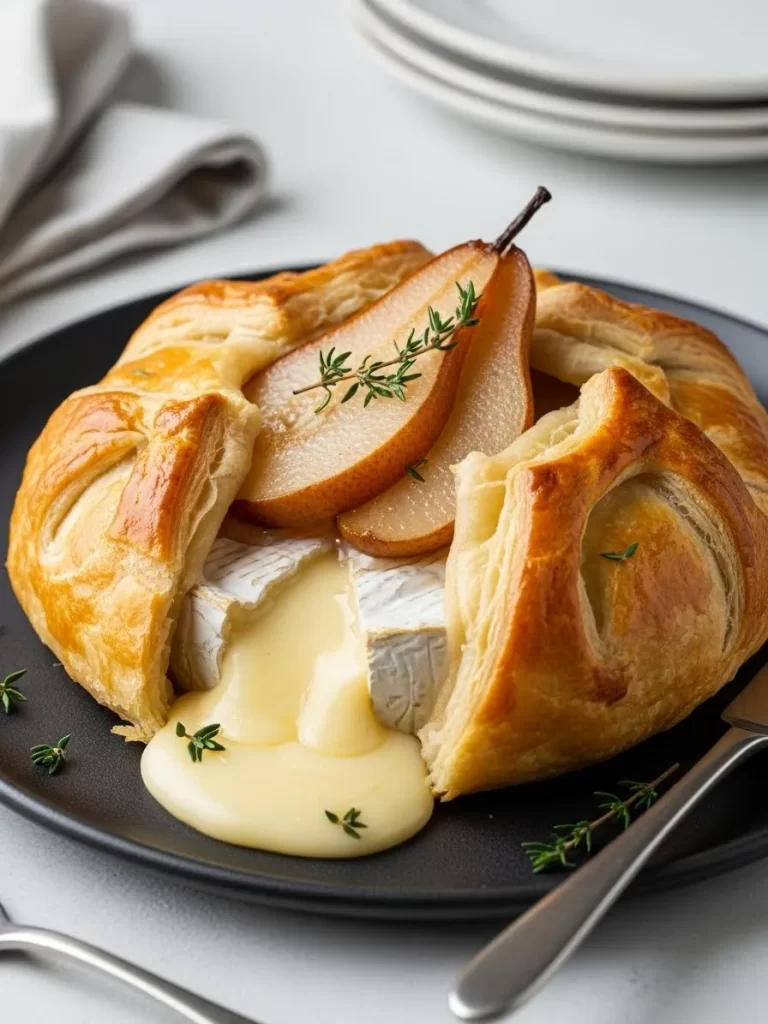
This luxurious main dish, or grand appetizer, is utterly decadent and stunningly presented. A wheel of creamy brie cheese is baked inside a golden puff pastry crust, with a melted, gooey center exposed.
The puff pastry is baked to a crisp, deep golden color, folded artfully around the brie. The crust is cut open on the side, allowing a river of pale, melted cheese to spill out onto the plate.
Two thin, glazed slices of pear, likely poached or caramelized, sit delicately on top of the pastry, garnished with small sprigs of fresh thyme. This combination of buttery crust, creamy cheese, sweet fruit, and savory herbs is undeniably festive and delicious.
Required Ingredients
- 1 sheet ready-rolled puff pastry (thawed)
- 1 wheel (8-10 oz) brie cheese
- 1 medium pear (Bosc or Anjou), sliced thinly
- 1 tablespoon melted butter
- 1 tablespoon brown sugar or maple syrup
- 1 tablespoon vegetable broth or water
- 1 egg (beaten, for egg wash)
- 1 teaspoon fresh thyme leaves or small sprigs
Equipment List
- Baking sheet
- Parchment paper
- Small saucepan
- Pastry brush
- Sharp knife
DIY Instruction
Step 1: Prepare and Assemble
- Preheat your oven to 400°F (200°C). Line a baking sheet with parchment paper.
- Unroll the puff pastry sheet. Place the wheel of brie cheese in the center.
- Fold the edges of the puff pastry up and over the sides of the brie, wrapping it loosely. You can trim away excess dough, but leave enough to seal the edges on top. Crimp the edges together.
Step 2: Glaze the Pears
- In the small saucepan, combine the melted butter, brown sugar/maple syrup, and vegetable broth/water. Bring to a simmer.
- Add the pear slices to the saucepan and cook gently for 3 to 5 minutes until they are slightly softened and coated in the glaze. Remove from heat.
Step 3: Bake
- Brush the entire puff pastry-wrapped brie with the beaten egg wash.
- Bake for 20 to 25 minutes, or until the pastry is deeply golden brown and puffed.
- Remove from the oven. Carefully arrange the warm glazed pear slices on top of the baked brie, followed by the fresh thyme sprigs.
- Allow to rest for 5 minutes before serving. Serve with crackers, bread, or fruit.
39. Wild Rice and Apple Stuffed Acorn Squash
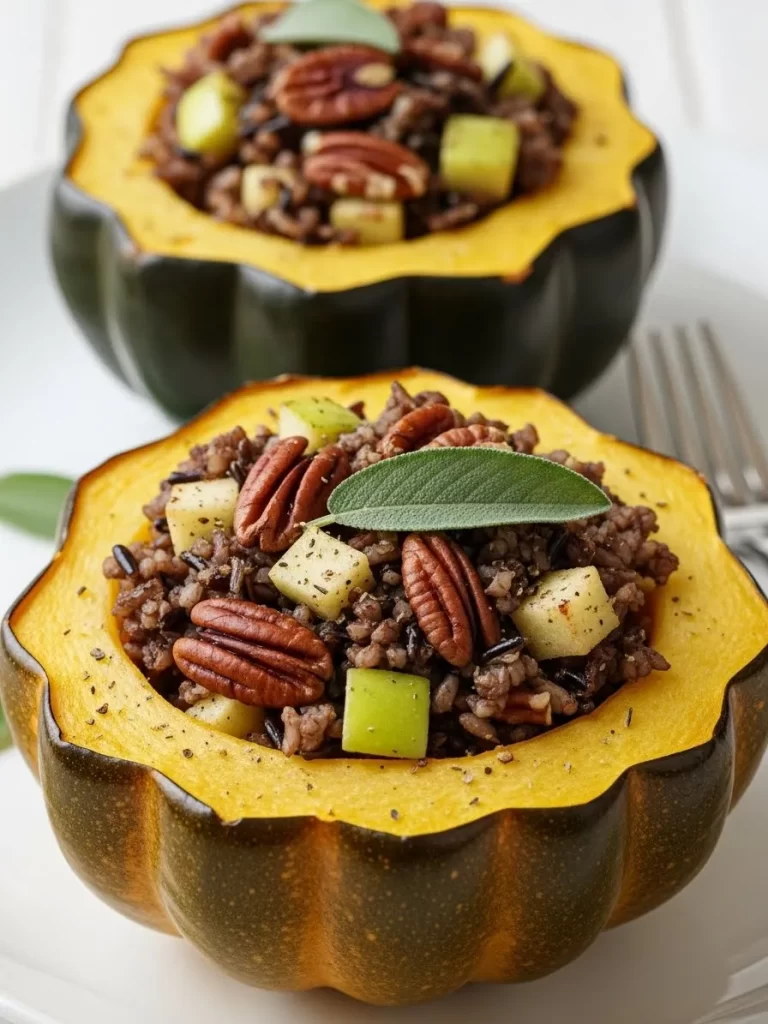
This classic autumnal dish is a comforting and visually appealing main course, presented as individual servings in halved squash bowls. The naturally ridged, dark green acorn squash forms a beautiful, warm serving vessel.
Each half of the roasted squash is filled with a mound of dark, savory wild rice or grain mixture. The filling is chunky and textural, incorporating finely diced green apples, which add a bright, tart counterpoint.
Whole, toasted pecans are scattered generously over the top of the filling, lending an earthy crunch and a rich, buttery flavor. A single fresh sage leaf garnishes the peak of the mound, providing a final touch of festive aroma.
Required Ingredients
- 2 medium acorn squash
- 1 tablespoon olive oil, plus more for rubbing
- 1 cup cooked wild rice blend
- 1/2 cup finely diced Granny Smith or other tart green apple
- 1/4 cup chopped yellow onion, sautéed
- 1/4 cup pecans, roughly chopped and lightly toasted
- 1/4 cup vegetable broth
- 1 teaspoon fresh sage, chopped, plus 4 leaves for garnish
- 1/2 teaspoon dried thyme
- Salt and black pepper to taste
Equipment List
- Baking sheet
- Sharp knife and cutting board
- Spoon or melon baller
- Mixing bowl
DIY Instruction
Step 1: Prepare and Roast the Squash
- Preheat your oven to 400°F (200°C).
- Carefully slice the acorn squash in half from stem to stern. Use a spoon to scoop out the seeds and stringy membranes from the center of each half.
- Rub the cut sides and cavities of the squash halves with olive oil, and season them with salt and pepper.
- Place the squash halves cut-side down on the baking sheet. Roast for 30 to 40 minutes, or until the squash is very tender.
Step 2: Prepare the Stuffing
- In a large mixing bowl, combine the cooked wild rice blend, diced green apple, and sautéed onion.
- Add the vegetable broth, chopped fresh sage, dried thyme, salt, and pepper. Gently stir until the ingredients are well mixed and the mixture is moist.
- Stir in half of the chopped, toasted pecans.
Step 3: Stuff and Finish
- Remove the roasted squash halves from the oven and turn them cut-side up.
- Spoon the prepared wild rice stuffing generously into the cavity of each squash half, mounding it slightly over the top.
- Return the stuffed squash to the oven and bake for an additional 10 minutes, just until the stuffing is heated through.
- Remove from the oven. Garnish the top of each stuffed squash with the remaining chopped pecans and one fresh sage leaf before serving warm.
40. Lentil Shepherd’s Pie with Sweet Potato Topping
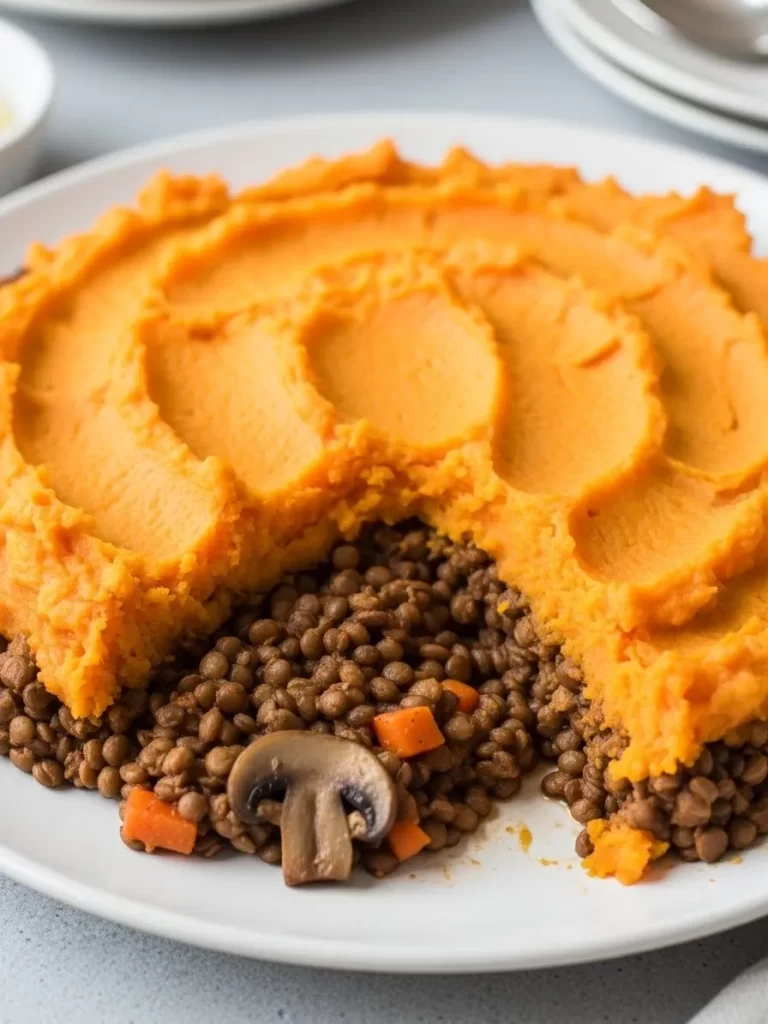
This classic, comforting dish is transformed into a gorgeous, hearty vegetarian main, presented with a vibrant orange topping. A generous wedge is removed from the pie, revealing the savory base underneath.
The topping is a beautifully piped or swirled layer of mashed sweet potatoes, providing a deep, rich orange color and a subtle sweetness. The top is lightly browned in spots, indicating a warm, creamy texture beneath the surface.
Beneath the topping is the savory “shepherd’s” base, featuring a dark, rich mixture of whole cooked lentils, providing the bulk and earthy flavor. Visible among the lentils are colorful chunks of diced carrots and a slice of mushroom, demonstrating the robust vegetable content.
Required Ingredients
For the Topping:
- 2 pounds sweet potatoes, peeled and cut into chunks
- 2 tablespoons butter or olive oil
- 1/4 cup non-dairy or dairy milk
- 1/2 teaspoon salt
For the Filling:
- 1 tablespoon olive oil
- 1 medium yellow onion, chopped
- 2 cloves garlic, minced
- 1 cup carrots, diced
- 8 oz cremini or button mushrooms, sliced (optional)
- 2 cups cooked brown or green lentils
- 1 cup vegetable broth
- 1 tablespoon tomato paste
- 1 teaspoon dried thyme
- 1/2 teaspoon dried rosemary
- 1 tablespoon cornstarch or flour (for thickening)
- Salt and black pepper to taste
Equipment List
- Large pot (for potatoes and filling)
- 9-inch round casserole dish or 8×8 inch square dish
- Potato masher or hand mixer
- Large skillet
- Cutting board and knife
DIY Instruction
Step 1: Prepare the Sweet Potato Topping
- Place the sweet potato chunks in a large pot and cover with salted water. Bring to a boil and cook for 15 to 20 minutes, or until the potatoes are very tender.
- Drain the potatoes well. Return them to the pot and add the butter/oil, milk, and salt. Mash or beat until the topping is completely smooth and creamy. Set aside.
Step 2: Prepare the Lentil Filling
- Preheat your oven to 375°F (190°C).
- Heat the olive oil in the large skillet over medium heat. Add the chopped onion and cook for 5 minutes until soft.
- Add the diced carrots and sliced mushrooms (if using). Cook for 8 minutes until the vegetables begin to soften. Stir in the minced garlic, tomato paste, thyme, and rosemary. Cook for 1 minute until fragrant.
- Sprinkle the cornstarch or flour over the vegetables and stir well. Cook for 1 minute.
- Stir in the cooked lentils and vegetable broth. Bring the mixture to a simmer, stirring until the filling thickens into a rich, savory sauce. Season with salt and pepper.
Step 3: Assemble and Bake
- Pour the lentil filling into the casserole dish and spread it out evenly.
- Spoon the sweet potato topping over the lentil filling. Use a fork or a piping bag to create an attractive, swirled or ridged pattern on the surface.
- Bake for 25 to 30 minutes, or until the filling is bubbling hot and the sweet potato topping is lightly browned in spots.
- Allow the pie to cool slightly for 5 to 10 minutes before serving.
Key Takeaways
- Elevate Your Menu: Vegetarian mains do not have to be side dishes. They should be celebrated centerpieces that anchor the entire holiday meal.
- Focus on Presentation: Recipes like Wellingtons, layered terrines, and sunburst tarts are naturally elegant and provide visual interest.
- Utilize Seasonal Flavor: Ingredients like butternut squash, cranberries, leeks, and mushrooms naturally lend themselves to rich, festive, and comforting dishes.
- Variety is Key: These recipes cover global flavors and different preparation styles (bakes, roasts, tarts, stews), ensuring you find a dish suitable for any gathering style.
You now hold the keys to transforming your holiday menu from standard fare to spectacular. Offering a vegetarian main dish that is both hearty and stunning ensures every guest feels celebrated and catered to.
Moving beyond simple sides and uninspired casseroles allows you to embrace the abundance of seasonal flavors and textures. Whether you choose the truffle pot pies or the dramatic crêpe cake, each dish offers an exciting opportunity for presentation.
This year, let your vegetarian main be the dish everyone talks about. These forty options are designed to provide warmth, richness, and visual excitement, guaranteeing that the true spirit of the season shines brightly on every plate.